


Integrating Innovation Capability into College Students’ Labor Education: A Practice-Based Teaching Model in an
Applied Undergraduate University
Xinglei Zhang¹, Qingli Wang²
¹ School of Mechanical Engineering, Jiangsu Ocean University, Lianyungang 222005, Jiangsu, China
² Xinghai Experimental Middle School, Lianyungang 222001, Jiangsu, China
*Corresponding author: Xinglei Zhang
Abstract
Addressing common challenges in higher education, including standardized learning activities, limited opportunities for authentic practice, and insufficient connections between professional learning and real-world problem-solving, this study proposes an integrated approach to developing students’ innovation capabilities through practical and labor-oriented learning. Focusing on applied undergraduate education, the study develops a student-centered and innovation-driven teaching model that integrates project-based learning, inquiry-based learning, and collaborative supervision. A three-stage progressive framework is designed to guide students from understanding the relationship between practical work and innovation to identifying real-world problems, developing solutions, and reflecting on their learning experiences. Through interdisciplinary teamwork, students undertake projects addressing practical needs, including the design of a multifunctional cleaning robot, a robotic dog-assisted luggage transportation system, and a real-time detection and collection device for shallow-water lotus roots. A multidimensional assessment framework emphasizing process and outcomes, individual and team contributions, and knowledge and innovation capabilities is used to evaluate students’ learning and practical performance. The implementation experience suggests that integrating authentic practical tasks with innovation-oriented learning can help move beyond routine and fragmented forms of practical education by encouraging students to identify problems, develop solutions, test prototypes, and reflect on their experiences. This approach provides a practice-based model for connecting experiential learning, innovation development, and professional education in applied undergraduate settings.
Keywords: labor education; innovation capability; academic competitions; practical teaching
1. Research Background
1.1 The Necessity of Integrating Labor Education into College Students’ Career Development
Labor education can play an important role in higher education by connecting students’ learning with practical activities, real-world problem-solving, and personal development. Beyond the acquisition of practical skills, labor-oriented learning can help students develop responsibility, perseverance, collaboration, creativity, and an appreciation of the social value of work. When appropriately integrated into university curricula, practical work can provide students with opportunities to apply disciplinary knowledge to authentic situations and to develop solutions to problems encountered in everyday and professional contexts [1].
In contemporary higher education, the growing emphasis on experiential and practice-based learning has created new opportunities to connect labor-oriented activities with academic and professional education. Rather than treating practical work as a separate or routine component of the curriculum, universities can incorporate meaningful tasks into disciplinary learning and encourage students to apply knowledge, technologies, processes, and problem-solving strategies to real-world challenges. Such an approach can strengthen the connection between theoretical learning and practice while creating opportunities for students to develop innovation capabilities through hands-on experience.
By connecting labor-oriented learning with project-based challenges and academic competitions, higher education institutions can create opportunities for students to move beyond theoretical learning and apply disciplinary knowledge to authentic problems. Such integration can strengthen students’ problem-solving, collaboration, creativity, and practical skills while encouraging them to take greater ownership of their learning. Engaging in meaningful projects and competitive activities can also provide valuable opportunities for students to develop innovation capabilities and prepare for the demands of professional practice and future careers [2,3].
1.2 Deepening Students’ Understanding of Labor Education and Innovation Capability
Labor education serves as a crucial component in higher education for fostering virtue and cultivating talents. Strengthening labor education helps enhance college students’ enthusiasm for innovation and entrepreneurship, which holds profound significance for national development and students’ personal growth [4,5]. During labor practices, students often encounter various challenges and problems that require them to think critically and attempt solutions. This process cultivates their innovation and problem-solving abilities, both of which are essential skills for their self-development [6].
In the era of artificial intelligence, technological advancements are rapidly evolving, with intelligent and automated technologies permeating every aspect of life and largely replacing traditional manual labor [7]. Technological development stems from innovation, which in turn originates from practical life experiences. Innovation capability is a vital means of achieving technological progress, while technological advancement represents the core objective and outcome of such capability [8]. Practice-based learning can provide students with opportunities to apply knowledge in authentic contexts while developing problem-solving and employability-related skills [9].
2. Implementation Process of Integrating Innovation Capability into College Students’ Labor Education
2.1 Analysis of the Current State of Labor Education in General Universities
The essence of labor education is to instill in students a spirit that respects, loves, diligently engages in, and honestly performs labor, enabling them to understand that labor is the source of happiness. In recent years, many universities have explored various approaches to labor education. For instance, some institutions offer a certain number of credit hours for theoretical and practical instruction. However, these programs are rarely systematically designed to integrate students’ professional backgrounds, knowledge systems, and practical platforms. There is a general lack of dedicated educational bases that combine academic disciplines with specialized labor practices, resulting in insufficient opportunities for students to engage in profession-related labor activities.
Furthermore, labor education in some universities focuses primarily on daily life education and service activities, such as personal laundry, dormitory cleaning, library book organization, and campus sanitation maintenance. While valuable, such activities often lack diversity and innovation, failing to fully encompass the broader educational potential of labor.
Additionally, certain universities implement labor education development plans that utilize point systems to encourage student participation. Although this method ensures student involvement in labor activities, it may lead to a lack of autonomy, initiative, and creativity in their approach to labor education.
2.2 Exploring Pathways for Integrating Innovation Capability into College Students’ Labor Education
As one of the first group of universities selected for the Jiangsu Province First-Class Applied
Undergraduate Institution Development Initiative, our implementation of labor education adheres to a philosophy of being “student-centered, innovation-oriented, and change-driven.” It actively integrates disciplinary expertise and professional training with practical internships, emphasizes the application of new knowledge, technologies, processes, and methods, and fosters creative problem-solving to cultivate innovative talents in specialized fields. Labor education is a pivotal component of fostering virtue and cultivating talent in higher education. Strengthening it helps enhance students’ enthusiasm for innovation and entrepreneurship, which holds profound significance for both national development and students’ personal growth. By infusing labor education into professional course instruction, engineering practice, and innovation-entrepreneurship education, we diversify its forms and integrate its ethos into the intellectual framework of academic competitions, thereby nurturing students’ practical labor skills and innovative spirit. Encouraging students to leverage their professional knowledge to creatively solve challenges encountered during labor education not only enhances intellectual engagement and innovation capability but also strengthens hands-on and problem-solving abilities. These elements mutually reinforce each other, collectively advancing educational development and talent cultivation.
2.2.1 Teaching Framework for Integrating Innovation Capability into Labor Education
The teaching framework for aligning innovation capability with labor education adopts a “three-stage progressive” model spanning one semester. In Stage 1, the essence of labor education in the new era—encompassing creativity, intellectuality, and service—is elucidated alongside the core elements of innovation capability, establishing their interconnection and introducing labor organization tools such as project management and teamwork. Stage 2 engages students in forming interdisciplinary teams to undertake complete project-based labor cycles centered on real labor needs both on and off campus, following the process of “problem identification–solution design–prototype development–testing and iteration” [10]. In Stage 3, students present their project outcomes and are guided to review and reflect on their application of innovative thinking, their experience of teamwork, and their individual growth throughout the labor process.
During this practice, students observed that outdoor glass surfaces are prone to dirt and are inconvenient to clean, while indoor ceiling dust is even more difficult to remove, with long-term accumulation affecting indoor air quality, aesthetics, and potentially fostering bacterial growth. Their investigation revealed a shortage of intelligent cleaning equipment for ceilings and exterior glass. Guided by national policies such as the “Robot+” Application Action Implementation Plan and the Special Equipment Safety Law, which encourage the use of robots to replace high-risk operations and promote intelligent equipment development, students innovatively designed a multifunctional cleaning robot, as shown in Figure 1. Students designed a multifunctional cleaning robot capable of moving across floors, walls, and ceilings. The project required students to integrate mechanical design, control, prototyping, and testing, thereby transforming a routine labor task into an interdisciplinary innovation project [11]. A patent application for this invention was submitted in December 2024 and is currently under substantive examination.
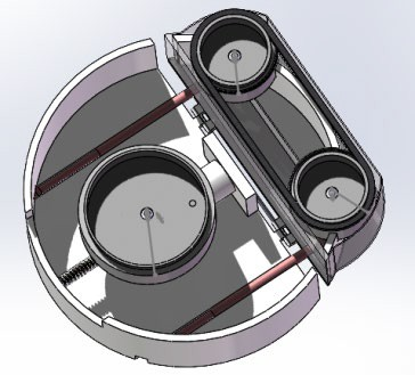
Figure 1. Multifunctional cleaning robot
The instruction is delivered through a modular approach, encompassing theoretical lectures (overview of innovation and labor, along with their integration); integration methodologies (including educational philosophy updates and teaching system optimization); case library development (collecting classic examples of “creative labor” both domestically and internationally, such as “universal design” and “smart agriculture” projects); and practical labor projects (topic selection for on- and off-campus labor activities, with comprehensive teacher guidance throughout).
Resource development leverages both on-campus facilities and social resources. By addressing practical problems encountered in labor practices, students are encouraged to devise solutions with teacher guidance. With support from school makerspaces and engineering training centers—equipped with tools such as 3D printers and laser cutters—innovative devices designed to solve these problems are manufactured. Additionally, collaboration with local governments and technology enterprises is established to introduce real-world project requirements and engage industry mentors in providing guidance.
Diverse instructional methods, including project-based, inquiry-based, and cooperative group learning, are employed in the organization and implementation. Students work in groups of 3–5 to fully undertake a “creative labor” project. A dual-mentor system is adopted during implementation: on-campus academic instructors provide theoretical guidance and process management, while enterprise or industry mentors oversee project direction and assess market feasibility. Class time is primarily dedicated to discussions, hands-on labor practice, and project-related theoretical instruction. Clear project milestones are established to ensure structured and orderly progress. Recent evidence suggests that project-based learning generally produces positive outcomes compared with traditional instruction, particularly in academic achievement and higher-order thinking, although the strength of the evidence varies across outcomes and methodological designs [12].
2.2.2 Teaching Methods and Evaluation for Integrating Innovation Capability into College Students’ Labor Education
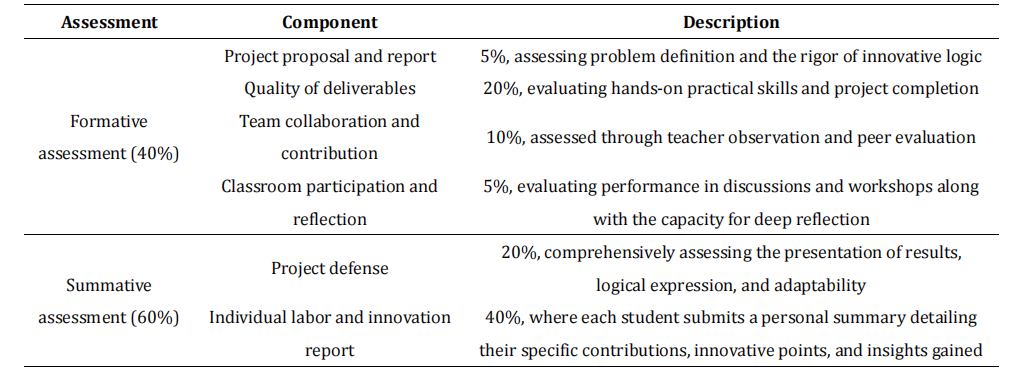
Course instruction employs a combination of theoretical learning and in-depth interaction. Regular project management and team communication are conducted either in the classroom or via collaborative platforms such as WeChat. In response to practical problems encountered during on- and off-campus labor practices, teachers and students immerse themselves in real-world scenarios, actively explore and exchange ideas, consider issues from multiple perspectives, stimulate innovative inspiration, and bring creative concepts to fruition. Students are encouraged to use low-cost materials for rapid prototyping, test their ideas through hands-on practice, and thereby embody the value of “labor.” Course evaluation adopts a diversified system based on “Process + Outcome, Individual + Team, Knowledge + Innovation Capability.” See Table 1.
Table 1. Assessment framework for innovation-oriented labor education
Through this designed pathway, the cultivation of innovation capability is internalized throughout the entire process of labor education. Students engaged in “creative labor” to solve real-world problems achieve synergistic improvement in knowledge, skills, and values. Simultaneously, they come to recognize that labor is the source of wealth creation and innovation is a vital force driving social progress. This further strengthens their sense of social responsibility, fosters correct values, and shapes them into well-rounded socialist builders and successors who embody moral, intellectual, physical, aesthetic, and labor development.
2.3 Practical Teaching Manifestations of Integrating Innovation Capability into Labor Education
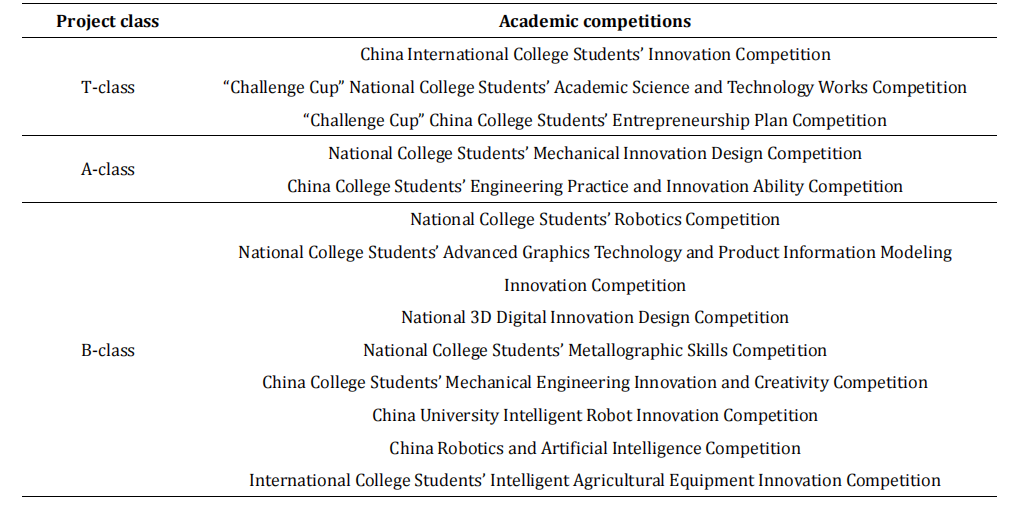
As a practical course in higher education, labor education is required by the Ministry of Education to encompass both theoretical instruction and practical teaching within the curriculum framework. Academic competitions for college students can be incorporated as a component of practical teaching. These competitions are closely related to students’ fields of study, helping to foster innovative thinking, develop creative capabilities, and cultivate teamwork awareness. The alignment of labor education with academic competitions can effectively guide students toward comprehensive development in moral, intellectual, physical, aesthetic, and labor dimensions. However, not all academic competitions are suitable for integration with labor education. It is necessary to identify a catalog of competitions relevant to labor education and skill development. Incorporating high-quality academic competitions into labor practice education helps students enhance their theoretical knowledge and practical skills [13]. Throughout the competition process, students not only solve problems but also improve their innovation capability and hands-on skills.
Taking mechanical engineering students’ participation in academic competitions as an example, this section explores pathways for integrating with labor education. Referring to our university’s 2023 recognized list of academic competition projects, competitions related to labor practice education for mechanical engineering majors are presented in Table 2.
Table 2. Academic competitions related to labor practice education for mechanical engineering majors
2.3.1 Robotic Dog-Assisted Luggage Transport During New Student Orientation
The start of the academic year is a highly anticipated event, with new students arriving from across the country in a continuous stream. Schools and departments typically organize student-led orientation activities, which include assisting newcomers with transporting their luggage to dormitories to ensure a smooth transition, as shown in Figure 2. While carrying luggage constitutes a form of labor, it is physically demanding work. The large number of new students often requires repeated trips, resulting in high labor intensity.
Fostering the ability to creatively solve practical problems is a defining characteristic of higher education in the new era. To address this, a robotic dog—originally developed as an entry for the World Robot Contest (a Category B competition)—was introduced to assist with luggage transport, as illustrated in Figure 3. Given that campus pathways often contain obstacles and continuous pedestrian flow, implementing this solution requires students to master technologies such as autonomous navigation, path planning, and obstacle-avoidance algorithms for the robotic dog. These technical competencies are directly applicable to the “Smart+” Intelligent Logistics and Handling Track of the China College Students’ Engineering Practice and Innovation Ability Competition (a Category A event). Thus, while engaging in physical labor, students simultaneously enhance their capabilities in robotic design, development, and engineering thinking.
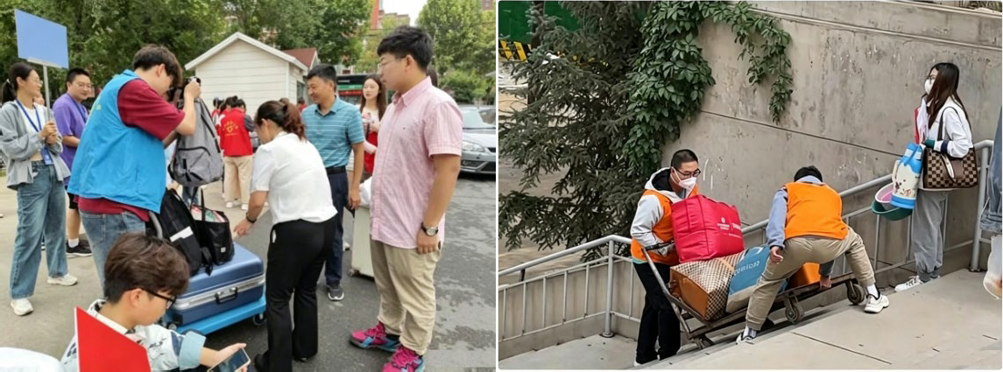
Figure 2. Students moving luggage during new student orientation
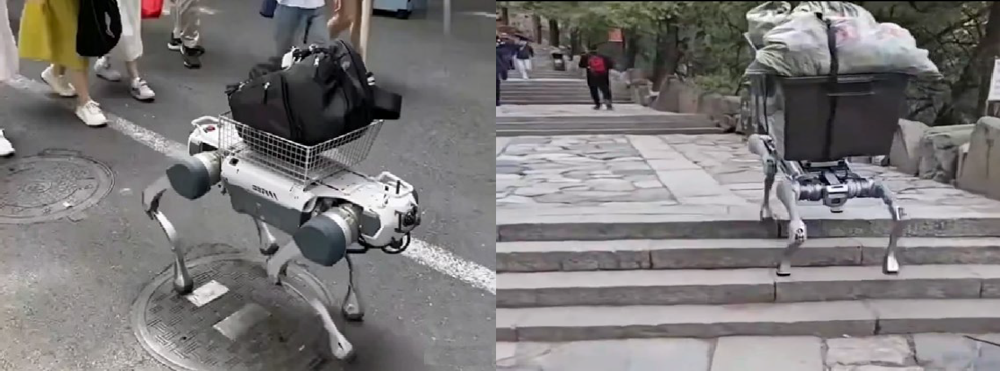
Figure 3. The robot dog carrying luggage
2.3.2 Design of a Real-Time Detection and Collection Device for Shallow-Water Lotus Roots in Labor Practice
Academic competitions require students to apply theoretical knowledge to solve practical problems, while labor practice provides a hands-on platform that enables them to deepen theoretical understanding and enhance their problem-solving skills. Both labor practice and academic competitions stimulate students’ innovative thinking, with innovation being a key factor in achieving outstanding results in competitions.
China remains a major agricultural country, where harvesting is a critical stage of agricultural production. Harvesting efficiency directly affects growers’ expectations regarding cultivation area. Inefficient harvesting leads to crop decay in the field, while rising labor costs further increase expenses. In many regions, shallow-water lotus roots are a primary crop, yet the digitization level of their harvesting process remains low. In a small number of areas, high-pressure water guns are used to flush away mud, allowing the lotus roots to float for collection. However, most regions still rely on farmers stepping on the roots to loosen them from the mud. This method is hindered by roots being trapped in sediment underwater, making the process extremely slow and outdated, as shown in Figure 4(a).
To address this, mechanical engineering students at our university developed a real-time detection and collection device for shallow-water lotus roots, illustrated in Figure 4(b). This device mechanizes and automates the harvesting process. By using photoelectric sensors to scan and provide real-time feedback on the harvesting status, along with artificial intelligence to control the device’s operating speed, the efficiency of the equipment is significantly improved. The design achieves the fundamental goals of complete and rapid harvesting. This project won a provincial third prize in the Mechanical Innovation Design Competition (Category A).
This work translates theoretical knowledge into practical labor, not only addressing the real challenges faced by farmers in harvesting lotus roots but also enhancing students’ innovation and teamwork capabilities. It stands as a perfect example of how labor practice and academic competitions complement and reinforce each other.
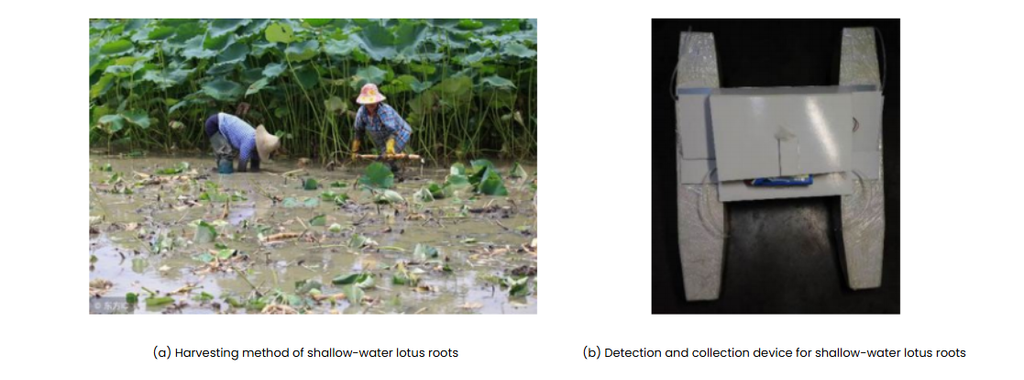
Figure 4. Shallow-water lotus root harvesting method and collection device
3. Distinctive Features and Innovations of Integrating Innovation Capability into Labor Education
Applied undergraduate institutions aim to cultivate advanced technical talents in specific professional fields. In implementing labor education, we adhere to the philosophy of being “student-centered, innovation-oriented, and change-driven.” This approach integrates labor education with innovative thinking, emphasizes the value and significance of labor in the context of innovation, and nurtures students’ practical labor skills and innovative spirit. Innovation capability is demonstrated through achievements such as performance in academic competitions, patent grants, and technology transfers. These outcomes serve as important references for assessing students’ labor competency and professional abilities, motivating them to actively participate, learn scientific and technological innovation through real labor practices, and thereby lay a solid foundation for future academic research and career development.
Aligning academic competitions with labor practice is a process that upholds the integration of labor education and professional education. Encouraging students to actively participate in domestic and international academic competitions not only enhances intellectual engagement and innovation capability but also strengthens hands-on skills and problem-solving abilities. These elements mutually reinforce each other, collectively driving educational development and talent cultivation. Academic competitions provide students with a platform for labor practice and the application of acquired knowledge. By applying theoretical expertise to practical labor, students not only increase their learning motivation but also develop their innovative capabilities. Academic competitions serve as a vital means of fostering education in scientific and technological innovation, while such innovation constitutes the core content and objective of these competitions. Through participation, students can learn about technological innovation within the context of labor practice, thereby establishing a strong foundation for their future academic and professional endeavors.
Building on disciplinary characteristics, labor education is integrated into professional course instruction, engineering practice, social service, and innovation-entrepreneurship education. This integration enhances the diversity of labor education and embeds it within the conceptual framework of innovation capability, where the value and significance of labor are emphasized. This approach cultivates students’ practical labor skills and innovative spirit. Achievements and performance in innovation capability serve as key references for evaluating students’ labor competency and professional abilities, incentivizing active participation.
4. Conclusion
Adhering to the principles of being “student-centered, innovation-oriented, and change-driven,” labor education is integrated into specialized curricula, emphasizing the expression of innovation capability through labor. By leveraging competitions to promote labor education and using labor to cultivate innovation, high-quality academic competitions are incorporated into labor practice education. The platform of competitions is utilized to enhance students’ intellectual engagement and practical skills. This mutually reinforcing model contributes to the advancement of education and talent cultivation, achieving the goal of holistic development in moral, intellectual, physical, aesthetic, and labor education. It shapes students into socialist builders and successors who possess a sense of social responsibility and uphold correct values.
Conflicts of Interest
The authors declare no conflicts of interest.
Copyright and License
Copyright in the article remains with the authors. Upon acceptance and publication, the authors grant Cytelix Press LLC. a non-exclusive license to publish, reproduce, distribute, display, and make the article available online as part of the journal’s scholarly record.
Unless otherwise stated on the journal website or in the publishing agreement, the published article will be distributed under the Creative Commons Attribution 4.0 International (CC BY 4.0) license. This license permits sharing and adaptation provided appropriate credit is given to the authors and the source, a link to the license is provided, and any changes are indicated.
References
[1] Xi, J. P. (2018, September 11). Emphasizing adherence to the development path of socialist education with Chinese characteristics and cultivating comprehensive development of socialist builders and successors. People’s Daily.
[2] Central Committee of the Communist Party of China, & State Council. (2020, March 20). Opinions on strengthening labor education in new era primary, secondary, and higher education. People’s Daily.
[3] Xi, J. P. (2022). Upholding the great banner of socialism with Chinese characteristics and striving for the comprehensive construction of a modern socialist country: Report at the 20th National Congress of the Communist Party of China. People’s Publishing House.
[4] Xue, C. J., Li, H., & Zhang, C. Y. (2023). Research and practice of labor education for college students based on engineering training courses under the new engineering background. Journal of Henan Education, (10), 67–69.
[5] Chen, Y. S. (2023). Research on the integration of labor education and innovation and entrepreneurship education for college students: A review of “Innovation and entrepreneurship education in higher education and labor education.” Yangtze River of the People, 54(3), 245.
[6] Ye, B. S., & Gao, F. Y. (2022). Labor-innovation integration: Construction and practice of a model for cultivating college students’ creative labor abilities based on innovation and entrepreneurship education. Labor Education Review, (1), 28–39.
[7] Liu, J. Y., & Ding, Y. J. (2024). Logical pathways for cultivating college students’ labor spirit in the context of artificial intelligence. Journal of Social Sciences of Shanxi Higher Education Institutions, 36(3), 47–52.
[8] Jiang, X. M. (2023). Research on the mechanism and path of integrating college students’ discipline competition activities with labor education. Special Zone Economy, (11), 129–132.
[9] Jackson, D. (2015). Employability skill development in work-integrated learning: Barriers and best practice. Studies in Higher Education, 40(2), 350–367. https://doi.org/10.1080/03075079.2013.842221
[10] Guo, P., Saab, N., Post, L. S., & Admiraal, W. (2020). A review of project-based learning in higher education: Student outcomes and measures. International Journal of Educational Research, 102, 101586. https://doi.org/10.1016/j.ijer.2020.101586
[11] Sjølie, E., Rødsjø, E., Skancke, L., Carvajal, P., Solhaug, S., Jensen, M. R., & Kaalvik, H. (2026). The empirical base of student project collaboration in higher education: A mapping review. Review of Educational Research. https://doi.org/10.3102/00346543261435632
[12] Farshad, S., & Fortin, C. (2026). An umbrella review of meta-analyses on project-based learning: Effects on academic achievement, higher-order thinking, and 21st-century skills. Educational Research Review, 52, 100809. https://doi.org/10.1016/j.edurev.2026.100809
[13] Björck, V. (2021). Taking issue with how the work-integrated learning discourse ascribes a dualistic meaning to graduate employability. Higher Education, 82, 307–322. https://doi.org/10.1007/s10734-020-00650-y