


Early Social Media Exposure and Child Development: Cognitive, Emotional, and Family-System Perspectives
Anna Antonella¹, Caterina Luigi¹*
¹ Department of Education, Faculty of Education Sciences, University of Almerı́a, Campus Universitario de La Cañ ada, 04120 Almerı́a, Spain
*Corresponding author: Caterina Luigi, Email: luigicaterina62@gmail.com
Abstract
Exposure to social media among children is happening at an earlier age, likely before they have fully developed cognitive, emotional, and digital literacy. While there has been some research on screen time and use among adolescents, there is a dearth of research on early exposure and developmental consequences in terms of cognitive, emotional, and family systems. This review analyzes the existing data on exposure to social media in children and cautiously uses research in adolescence and youth to determine developmental processes and effects of increased online exposure. Convergent patterns, risk and protective factors, and explanatory mechanisms were identified based on quantitative and qualitative findings relying on socioecological and family mediation models. The impacts of being exposed to social media early depend on the stage of development, use patterns, content, and contexts. Emotional associations with social comparison, anxiety, mood instability, and disrupted sleep have been indicated in the literature, but most of these data are from larger youth or adolescent samples. Early exposure to social media can also be associated with changes in parent-child relationships and parental boundaries, while active mediation and instructed co-use are associated with better understandings. The impact of early exposure to social media needs to be understood as a phenomenon that happens at a system level and is influenced by a parent’s control and mediation of social media use as well as by the time of exposure. However, longitudinal, culturally sensitive research is required to provide evidence-based recommendations for parents, policymakers, and digital platform designers.
Keywords: social media exposure; early childhood development; cognitive impact; emotional well-being; family mediation; parent-child dynamics
1. Introduction
There has been a great advancement in technology, as reflected in recent research conducted on early media exposure of children. The research on television (TV) watching, educational TV, and the overall amount of screen time was predominant in the 1990s and the early 2000s, with researchers concentrating on such outcomes as attention, learning, sleep, language development, and behavior [1]. The media exposure of children during this time was often considered relatively passive, scheduled, and home-based, and studies often used parent-reported viewing hours, program type, and correlations with developmental outcomes. The expansion of computers, internet access, and mobile phones and tablets in the late 2000s and 2010s has shifted the emphasis to interaction that is interactive, mobile, and “always on” [2]. Researchers began to change their focus from measuring total screen time to the content consumed, context of screen use, multitasking with screens, autonomy of the child’s use, platform-specific design, and considerations from care takers/mediators [3]. For instance, as social networking applications and websites gained popularity, most notably Facebook, YouTube, Instagram, Snapchat, and TikTok, features such as liking, peer visibility, following others, and apps that provide push notifications, along with an algorithmic feed and short-form video, have gained increasing scholarly interest [4]. These have resulted in children being exposed to more social and incentive-based content than in previous TV or whole-screen time paradigms. To understand early exposure to social media, the evidence should be considered in a broader context: why have people shifted to mobile viewing and algorithmically curated digital content [5]?
More recently, children have entered a new stage of digital environments dominated by generative artificial intelligence (AI), immersive social technologies, and increasing regulatory focus on their safety in online environments. Children are exposed daily to new and different ways of communicating through AI-produced texts, images, videos, and chatbots that are changing how they engage with information, creativity, misinformation, online risks, and identity presentation [6]. At the same time, spaces for virtual reality or to meet with other users, like a virtual “metaverse,” offer a new form of digital communication that is more than just a feed and screen, including avatar-based or immersive communication that might spark issues of privacy, lack of supervision, social presence, harassment, and developmental appropriateness. Meanwhile, governments, along with regulators, have begun to implement stricter child online safety policies, including access limits for underage social media, government and/or platform-level requirements to protect the underage, and age-assurance [7]. The development means that it is fast growing to include a more multifaceted type of digital ecological approach, which can help shape children’s experiences online collectively through algorithmic recommendation, AI-generated content, immersive interaction, and platform regulation.
Although initially social media were predominantly used by adolescents and young adults, there has been a growing trend in social media use in younger age groups, as smartphones, tablets, and other devices have become ingrained in families’ lifestyles. Therefore, children under 12 are more likely to be introduced to social networking environments, often before they have the cognitive and emotional abilities to operate within the environment and/or the digital literacy skills to critically engage [8]. But, unlike old-school screen time, social media combines entertainment with peer comparison and interaction, algorithmic suggestions, and rewarding feedback. This renders exposure to social media during early development of a child developmentally different as compared to watching television or screen time in general. For this reason, previous screen time research is a useful baseline, yet it does not cover all aspects of development of the interactive and algorithmically curated platforms [9].
Another concern is the rise of algorithmic content delivery. Previous research on screen time has largely been based on a time-centric approach to defining children’s exposure to media usually selected by a caregiver, which assumed a linear form of media. Rather, apps such as YouTube are increasingly dependent on recommendation algorithms, brief videos, endless scrolling, and feedback based on engagement to customize and maintain visibility. The exposure of children is now not just influenced by the time they spend on the internet alone but also by algorithm sequencing, personalization, and patterns of reinforcement, which were not considered in the models of “screen-time” that were fully envisaged beforehand [10,11].
Childhood is a sensitive time of brain development, formation of identity, and social learning. The executive functions, impulse control, and emotional regulation systems in children during early and middle childhood are still in the process of maturation. As they are increasingly exposed to social media, there are questions about how this exposure at such a young age affects the developmental process. Even as social media offers new ways of communicating and self-expression, it also poses threats to the critical period of rapid neurological and social development [12,13]. Figure 1 presents a conceptual model summarizing how platform design features interact with children’s developing cognitive and emotional systems within the family and broader sociocultural context to produce risk or protective developmental pathways. This review aims to review the existing evidence on early exposure to social media and its associations with children’s cognitive, emotional, and family-system development. Specifically, it seeks to: (1) examine how early exposure to social media relates to the development of attention, working memory, and executive function; (2) evaluate associations between early social media exposure and emotional and mental-health outcomes, including self-esteem, mood, and social comparison; (3) explore how early exposure shapes family dynamics, parental mediation practices, and parent-child relationships; (4) identify risk and protective factors, including developmental stage, content type, and context of use, that moderate these outcomes; and (5) highlight gaps in the current evidence base, particularly the scarcity of direct data on children under 12 years, in order to inform future longitudinal and culturally sensitive research.
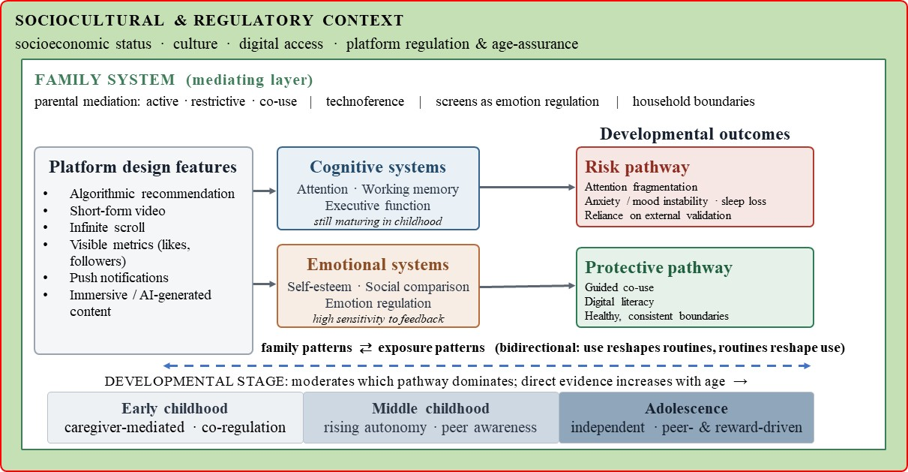
Figure 1. Conceptual model of early social media exposure and child development. Platform design features (such as algorithmic recommendation, short-form video, infinite scroll, visible metrics, push notifications, AI-generated content) act on children’s developing cognitive systems (attention, working memory, executive function) and emotional systems (self-esteem, social comparison, emotion regulation), producing either a risk pathway (attentional fragmentation, anxiety, sleep loss, reliance on external validation) or a protective pathway (guided co-use, digital literacy, healthy boundaries). Both pathways are moderated by the family system (parental mediation, technoference, household boundaries) and embedded within the broader sociocultural and regulatory context, with their relative dominance shifting across developmental stages.
2. Methodology
This is a narrative review where a structured, transparent search strategy was used. Database searches were conducted between January 2015 and July 2026 (final update in August 2026), a period selected to capture the emergence and growth of research on interactive, algorithmically curated social media, as distinct from earlier screen-time research. Foundational theoretical works predating this window were identified through backward referencing.
Scopus, Web of Science, PubMed, ERIC, and APA PsycInfo were searched, chosen for their combined coverage of psychology, education, and health sciences literature. Search terms combined (“social media” OR “digital media” OR “screen time” OR “screen use”) AND (“children” OR “child” OR “early childhood”) OR (“cognitive development” OR “emotional development” OR “family dynamics” OR “parent-child relationship”).
Studies were included if they: examined children/adolescents up to 18 years old (with particular attention to under 12); addressed social media, digital media, or screen-based exposure; reported cognitive, emotional/mental-health, or family-system outcomes; were peer-reviewed empirical studies, reviews, or meta-analyses; and were published in English. Studies were excluded if they were television-only/non-interactive screen studies, non-peer-reviewed commentaries, studies limited to clinical/diagnosed populations, or studies without full-text access.
Titles and abstracts were screened for relevance, followed by full-text review of eligible studies, with backward referencing supplementing the database search. Given the heterogeneity of designs and outcomes, findings were synthesized narratively by developmental domain (cognitive, emotional/mental health, family system), interpreted by methodological approach, developmental stage, exposure type, and contextual moderators.
3. Impact of Social Media Exposure
The results are reported in the developmental domain to shed light on the relationship between exposure to social media at a young age and cognitive, emotional, and family-level outcomes. The evidence within every domain is interpreted with respect to the approach to methodology, stage of development, type of exposure, and moderators of context.
3.1. Impact on Cognitive Functioning
Cognitive development is a process that entails gradually enhancing mental operations that enable children to process information, take control over their actions, and undertake increasingly more complicated learning activities. During childhood, there are still developing processes highly susceptible to factors such as the environment, the highly stimulating nature of social media and the so-called cognitive systems (attention, working memory, and executive functioning) [14,15].
A major determinant of cognitive development is maturation of attention, the ability to focus on a specific activity and filter out distracting information. Gaining the ability to listen is the basis for almost all academic and real-life processes, including extended listening in the classroom and multi-step processes. Nevertheless, the attentional networks of children are still maturing and, thus, are specifically vulnerable to quick, extremely salient visuals, which is a characteristic of social media content [16,17].
Memory, the mental “notebook” that helps children to process information, understand instructions, find solutions to problems, and acquire new information, is closely connected with attention. The main challenge when it comes to working memory is sustained attention; with constant attention being pulled away by digital distractions and/or notifications, children may not be able to hold on to information long enough to be productive with it. These distractions have the potential to disrupt learning effectiveness and performance on tasks that involve extended mental activities [18]. Children’s executive functioning, which refers to a set of higher-order abilities, also develops as they grow and helps them to plan, organize, manage impulses, and persevere to work through challenges. These skills are dependent on the maturation of the prefrontal cortex, which is still developing during early and middle childhood. Any environment that continuously rewards quick reactions and constant novelty (such as social media) can put additional strain on developing executive functioning and lead to behaviors that are based on a goal-oriented basis [19,20].
There is a need to understand the cognitive meaning of early exposure to social media according to developmental levels. The main concern with the youngest (toddlers to preschool-aged children) who are still developing their attentional control and self-regulation abilities is exposure to screen-based stimulation, short-form video, and caregiver-mediated digital content [21]. In middle childhood, children begin to be more independent in dealing with digital platforms, and sustained attention, working memory, and impulse control are increasingly important. The results involving adolescent samples are incorporated in the review to explain mechanisms that appear later in life, including reward sensitivity, multitasking, and engagement driven by peers, but they cannot be considered to be directly comparable to those of younger children [14,22].
The Adolescent Brain Cognitive Development (ABCD) Study is a longitudinal study that provides relevant evidence for overall screen-media exposure because it involves young children and is tracked during adolescence. The research based on ABCD has investigated the correlation between general screen activities and cognitive, behavioral, mental health, sleep, and academic outcomes [23,24]. While these findings are helpful to summarize overall developmental patterns of screen exposure, they do not directly measure the contribution of the social media platform, algorithmic feed, short-form video, or the engagement design features themselves. Recent research identified associations between screen use and mental health, academic performance, sleep, and peer outcomes, while other research suggested that it is important to identify specific types of screen use instead of treating it as a single variable. More recent longitudinal studies based on ABCD indicate that screen time in late childhood can be prospectively linked to the subsequent manifestation of mental health symptoms, but the effects are small in most cases, with differences depending on the modality and context of screens [25,26].
Some studies on screen exposure generally focus on attention and cognition; however, there are some interesting platform-specific studies that suggest new demands with certain aspects of social media. One of the concerns, in particular, is attention, because the social media environment is made up of high-intensity stimuli. There are some traits that could underlie fluctuations in attention and may be more prevalent on modern content platforms, specifically TikTok, YouTube Shorts, and Instagram Reels: short videos, flickering images, infinite scrolling, fast-paced feeds (recommended content), and constant push notifications [27]. Reconceptualization of this fast-paced content is suggested as a potential source of short-lived, discontinuous patterns of engagement that lead to lower focus on less interesting activities. This, over time, can also cause issues with attention in activities that require extended patience (reading, homework, and following classroom instructions). Multitasking is also encouraged by social media with the barrage of messages and updates, which makes users more likely to switch to another type of social media and activity. Multiple studies indicate relationships between the use of digital media and attentional problems, but the results vary in terms of age group, the definition of exposure, and outcome measure [28–30].
3.2. Impact on Emotional/Mental Health
There may be a relationship between early exposure to digital and social media and emotional development. However, there is not much direct evidence in children younger than 12 years. Childhood is an emotionally sensitive time of life, as children are still developing the ability to read emotions, deal with stress, and social feedback [14,31]. On social media, users can actually see feedback through pictures, likes, comments, reactions, and comparative results. However, little research exists on these platform-specific experiences among adolescents, rather than younger children. The digital aesthetics that come with such applications may elicit very strong emotions from children. Social media can be woven into children’s emotional experiences so that when they take increasing responsibility for managing communications on the Internet, they learn about themselves, about others, and how to manage their emotions [32,33].
The effects of emotions also depend on the stage of development. In early childhood, all engagement with social media is indirect (e.g., via caregivers), and concerns at this stage center on emotional co-regulation, exposure to overstimulating content, and sleep disturbance/display of dependency on this media for soothing/care [34,35]. During middle childhood, children pay more attention to peers’ reactions, rejection on the internet, and praise given through digital devices, and they have become more conscious of issues arising from self-esteem and peer comparison. Issues of identity formation, appearance, peer acceptance, cyberbullying, and fear of missing out (FOMO) are more pronounced during adolescence. Hence, results involving adolescents are incorporated only to put developmental patterns and processes in perspective that may escalate with age and not to imply that they will have the same effects on younger children [36].
In young children, longer screen time has been linked to worse mental health, increased behavioral issues, poor sleep, and worse academic performance, although these relationships vary with the type of screen activity. Screen exposure at ages 9–10 can be associated with internalizing symptoms (depression, anxiety) and externalizing symptoms (ADHD, oppositional defiant, conduct) over 1 and 2 years of follow-up [37,38].
General evidence on “screen time” can provide a broader, non-specific background acceptance of effects of social media, but should not be interpreted as evidence of social media-specific effects. For example, a national survey representing the entire youth population (2-17 years old) in the U.S. found that increased screen use is associated with worse psychological well-being, such as decreased emotional stability, lower curiosity, and difficulties in making new friends and maintaining friendships [39,40]. Long screen time was found to be associated with a higher risk of depression or anxiety, as well as increased potential for mental health treatment among adolescents (14-17 years). Several studies also highlight that the relationships are typically small and that they are also moderated by screen content, context, age, gender, and replacement of sleep or physical activity. Other more recent longitudinal data also indicate that sleep disturbance is a possible cause of the relationship between evening or leisure screen time and future depressive symptoms, particularly in adolescent girls [41,42].
The social comparison, visible feedback, FOMO, cyberbullying, and appearance-based content evidence, by contrast, deals with studies of social media use among adolescents rather than children. Young children are heavily reliant on feedback from others to understand their own worth, and this can be reinforced by social media [43,44]. Social judgment is public, observable, measurable, and immediate on digital platforms, and everyday acts of approval and disapproval are transformed into the digital space. For children who have to work through the complicated identity formation process, online engagement quantitative indicators (likes, comments, and number of followers) might take disproportionate significance [45]. Online peer feedback is a type of reflected appraisal that helps young people to perceive themselves and how they are perceived by others, which consequently affects self-concept and self-esteem. These metrics are more critical for children who are forming a sense of identity. Online feedback can be understood as significant judgments, which result in increased self-consciousness and inadequacy. The social media interactions that are qualitative in nature, like the valence of feedback and the inclination towards social comparisons, may compound the preoccupation with the external appraisals being experienced by youth [46,47]. Adolescents have higher sensitivity to negative feedback than positive feedback, which is correlated with lower self-esteem and higher identity distress. Furthermore, the digital domain could also be a place of virtual social mirroring, and idealized images and filtered portrayals of others are possible points of comparison of self-worth, bringing a potential for identity confusion and a sense of inadequacy. These results have found mechanisms that can be more pertinent when children are approaching adolescence but fail to determine similar effects in younger children [48,49].
3.3 Impact on Family System
Social media not only affects children’s everyday lives, but it also brings modifications to family life. The new generation of digital technology is now entrenched in home life, and parents and children need to navigate the evolving landscape of interactions, attention, and communication [50]. Such digitally mediated processes are often quite distinct from those of previous generations, and they alter people’s experiences of transitions in terms of family, boundaries, and bargaining of presence and availability within everyday life. For younger children who are developing a sense of relationships, these changes could affect their understanding of parental participation, presence, and boundaries in the family. Whether in conjunction or independently, how the family uses social media, as well as the potential that children have for using it, can change the perceived expectation of time, attention, and bonding and act as catalysts or tensions within the family system [50–52].
The impact of digital media on family life also varies at different levels of development. They are essentially selected family members, choice of caregiver (e.g., a screen to help the child relax), co-viewing, and early “routine.” The need for more freedom begins during middle childhood; thus, setting rules, getting parental mediation, and regular boundaries are quite important [53]. By preadolescence and adolescence, negotiations between family and privacy, communication with peers, access to platforms, and dealing with online risks are subjects of discussion. This disparity in growth is important because how parents operate can affect how they look at the children with regard to their age, independence, and proficiency in the digital world [31,54].
One of the most noticeable shifts in today’s families is the use of tablets, phones, and other electronic devices to govern children’s behaviors. Caregivers make use of iPads, YouTube videos, or applications for children as a convenient source of amusement, a trivial time killer, and as a de facto “babysitter” in very practical terms [55]. Parents commonly spend time with children using digital media as a stress-reduction or entertainment activity as digital devices and streaming become more prevalent in everyday life. Although screens can be a quick distraction or relaxation, there is increasing research on what people often refer to as incidental developmental costs: frequent use of screens to calm emotions [56,57]. Recent studies have demonstrated that using digital media regularly as a regulation strategy is associated with reduced opportunities for caregiver-child co-regulation, a key factor for the acquisition of adaptive emotion regulation in early and middle childhood. By replacing interpersonal care with digital media, children might lose opportunities to practice self-soothing, imaginative play, and learn to interpret and react to minor cues of social interaction, which are important aspects of social-emotional competence [58]. Moreover, prospective research has identified increased screen dependence in calming (especially negative emotional) states to predict increased levels of internalizing symptoms and worse executive functioning in the future, indicating that reliance on screens to calmly respond to negative emotions could be inadvertently recreating the reliance on external stimulation instead of the acquisition of internal coping responses [59].
Along with the increasing reliance on digital media, many families are finding it hard to establish and enforce restrictions on digital media. The latest recommendations of the American Academy of Paediatrics (AAP) highlight the fact that the regulations of screens in the home are not clearly discussed or implemented, especially when the parent is stressed, tired, and has to balance work and family [60]. A family systems perspective would reveal that such inconsistency may also bring about ambiguity in expectations and roles, and this will more likely result in conflict and negotiation regarding screen use. Children may develop strange habits when boundaries are different in various situations, or based on different caregivers, and require more resorting to technology than is normal, which can make life difficult [61]. Such processes can impair the self-regulation process by transferring behavioral control to external stimuli. The unpredictable nature of technology boundaries has been associated with disrupted sleep and reduced face-to-face interaction and shared activities among family members, which are critical spaces for emotional regulation, social learning, and family bonding over the years [62]. Figure 2 summarizes how the cognitive, emotional, and family-level patterns described above shift across developmental stages, from caregiver-mediated exposure in early childhood to increasingly autonomous, peer- and reward-driven engagement in adolescence.
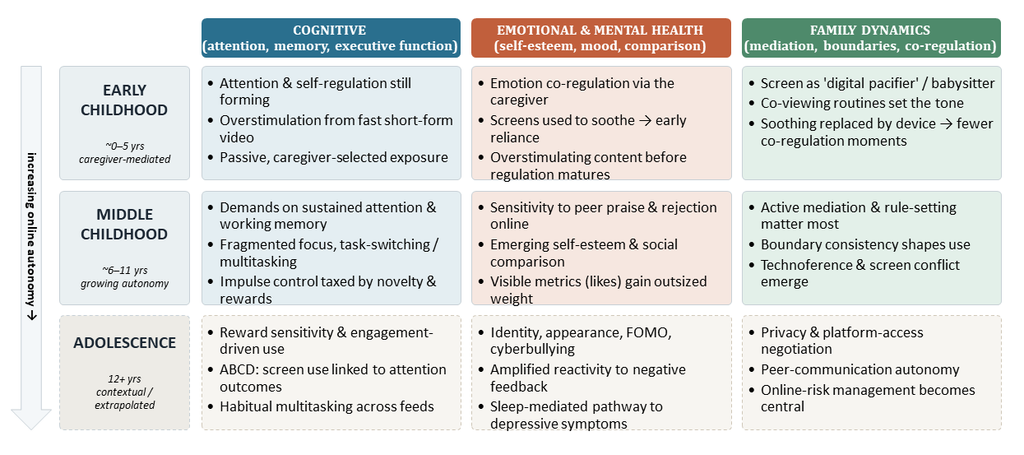
Figure 2. Developmental progression of cognitive, emotional, and family-level correlates of social media exposure across early childhood (0–5 years, caregiver-mediated), middle childhood (6–11 years, growing autonomy), and adolescence (≥12 years). Columns show the three domains reviewed: cognitive (attention, memory, executive function), emotional/mental health (self-esteem, mood, social comparison), and family dynamics (mediation, boundaries, co-regulation). Adolescent-stage entries draw on adjacent literature and illustrate developmental trajectory rather than confirmed effects in younger children.
4 Conclusion
The growing influence of social media in children cannot be perceived as a system of independent effects on cognition, emotion, or family life, but as a system of dynamic development. Nevertheless, there is a disproportionate distribution of the available evidence by age groups. These patterns of reaction to the platform differ with the developmental stages of children, particularly with their underdeveloped skill sets of digital literacy, executive functioning, emotional control, and attention. Therefore, cognitive and emotional consequences go hand in hand: impulsive use may lead to higher dependence; receiving emotional feedback that is salient to oneself may lead to increased stress, self-consciousness, or dependence on others’ validation; comparison may result in increased stress, self-awareness, or external validation; online presence may increase stress or feelings of disconnection. More evidence is required to make a definitive conclusion.
Families play an important role in this context. Family routines, parent mediation, digital literacy, socioeconomic status, and family boundaries impact children’s interaction, expression, and behaviors with social media. Interestingly, the effect of exposure alone is not mediated by family systems but is replicated at subsequent exposure levels. For example, ad hoc rules, technoference by parents, or screens as a comfort may be considered normal, with more frequent and/or less regulated use, but active mediation, co-use, and boundaries may reduce risk and encourage more developmentally appropriate practices with screens. The mutual dependence means that exposure to social media can change family interaction patterns and vice versa, such as family interaction patterns that can predetermine how the exposure will be more or less structured, supportive, or problematic. Lastly, future studies need to explore the effects of emerging types of algorithmic platform design, such as recommendation systems, short-form video feeds, both engagement metrics and push notifications, and infinite scrolling, on children over time; whether developmental risks are mediated primarily by total screen time or by all of these features of platform design; whether mediation by parents, co-use, and culturally-specific family norms can decrease the impact of these features of platform design, or whether they should be designed to create developmentally appropriate, culturally responsive, and child-centered digital experiences.
Conflicts of Interest
The authors declare no conflicts of interest.
Author Contributions
Conceptualization: Anna Antonella
Writing – Original Draft: Anna Antonella, Caterina Luigi
Writing – Review & Editing: Caterina Luigi
All authors have approved the final version of the manuscript.
Copyright and License
Copyright in the article remains with the authors. Upon acceptance and publication, the authors grant Cytelix Press LLC. a non-exclusive license to publish, reproduce, distribute, display, and make the article available online as part of the journal’s scholarly record.
Unless otherwise stated on the journal website or in the publishing agreement, the published article will be distributed under the Creative Commons Attribution 4.0 International (CC BY 4.0) license. This license permits sharing and adaptation provided appropriate credit is given to the authors and the source, a link to the license is provided, and any changes are indicated.
References
[1] Kar, S. S., Dube, R., Goud, B. K. M., Gibrata, Q. S., El-Balbissi, A. A., Al Salim, T. A., & Fatayerji, R. N. M. A. K. (2025). Impact of screen time on development of children. Children, 12(10), 1297.
[2] Toth, C., Osser, B., Bondar, L. I., Fazakas, R., Marcu, F. M., Pascalau, N. A., Suciu, R. N., & Dogaru, B. G. (2025). Associations between screen time, sleep, and executive function in school-aged children and adolescents: The moderating role of digital content and age. Journal of Clinical Medicine, 14(24), 8842.
[3] Sachdeva, A., Ahmed, N., & Sachdeva, A. (2025). The digital generation: Unraveling the impact of screen time on adolescent development, health risks, and well-being. Adolescência e Saúde, 20(3), 13–27.
[4] Singh, P., & Singh, A. K. (2025). The digital revolution: Exploring new media in the 21st century. Crown Publishing.
[5] Mascheroni, G., & Zaffaroni, L. G. (2025). From “screen time” to screen times: Measuring the temporality of media use in the messy reality of family life. Communications, 50(1), 63–84.
[6] Katharina, A. (2025). Children’s rights in digital spaces: Emerging legal and societal perspectives. Stout in Law and Societal Studies, 1(1), 26–40.
[7] Lala, A. (2025). Metaverse-based cyber harassment and virtual reality: A critical review of the current legal framework and recommendations on normative needs. Indonesian Cyber Law Review, 2(2), 74–90.
[8] Pater, J. A., Miller, A. D., & Mynatt, E. D. (2015). This digital life: A neighborhood-based study of adolescents’ lives online. In Proceedings of the 33rd annual ACM conference on human factors in computing systems.
[9] Wadsley, M., Covey, J., & Ihssen, N. (2022). The predictive utility of reward-based motives underlying excessive and problematic social networking site use. Psychological Reports, 125(5), 2485–2516.
[10] Buro, A. W., & Serena Gomes, M. M. (2026). Rethinking social media in youth health promotion: Navigating ethics, equity, and algorithmic risk. American Journal of Health Promotion, 08901171261448035.
[11] Radesky, J., Bridgewater, E., Black, S., O’Neil, A., Sun, Y., Schaller, A., Weeks, H. M., & Campbell, S. W. (2024). Algorithmic content recommendations on a video-sharing platform used by children. JAMA Network Open, 7(5), e2413855.
[12] Idyan, Z. (2025). The impact of YouTube content on child psychology: A comprehensive study. Jurnal Ilmu Psikologi dan Kesehatan (SIKONTAN), 3(4), 155–162.
[13] Kim, D., Lee, S., Kim, H., & Shin, Y. (2024). From temperament to YouTube: Exploring the link between childhood temperament, YouTube usage patterns, and emotional/behavioral problems among children. BMC Public Health, 24(1), 1547.
[14] Clemente-Suárez, V. J., Beltrán-Velasco, A. I., Herrero-Roldán, S., Rodriguez-Besteiro, S., Martínez-Guardado, I., Martín-Rodríguez, A., & Tornero-Aguilera, J. F. (2024). Digital device usage and childhood cognitive development: Exploring effects on cognitive abilities. Children, 11(11), 1299.
[15] Shanmugasundaram, M., & Tamilarasu, A. (2023). The impact of digital technology, social media, and artificial intelligence on cognitive functions: A review. Frontiers in Cognition, 2, 1203077.
[16] Conkbayir, M. (2022). The neuroscience of the developing child: Self-regulation for wellbeing and a sustainable future. Taylor & Francis.
[17] Cooper-Kahn, J., & Dietzel, L. (2024). Late, lost, and unprepared: A parents’ guide to helping children with executive functioning. Taylor & Francis.
[18] Gathercole, S. E., & Alloway, T. P. (2004). Working memory and classroom learning. Dyslexia Review, 15, 4–9.
[19] Begum, A. J. (2025). Cognitive control skills. In Cognitive control skills for educational success: Theory and practice (pp. 1–38). Springer.
[20] Otero, T. M., & Barker, L. A. (2013). The frontal lobes and executive functioning. In Handbook of executive functioning (pp. 29–44). Springer.
[21] Nikolaeva, E. I., & Kalabina, I. A. (2023). Ground rules for preschooler exposure to the digital environment: A review of studies. Psychology in Russia: State of the Art, 16(4), 37–54.
[22] Maeneja, R., Rato, J., & Ferreira, I. S. (2025). How is the digital age shaping young minds? A rapid systematic review of executive functions in children and adolescents with exposure to ICT. Children, 12(5), 555.
[23] Nagata, J. M., Al-Shoaibi, A. A., Leong, A. W., Zamora, G., Testa, A., Ganson, K. T., & Baker, F. C. (2024). Screen time and mental health: A prospective analysis of the Adolescent Brain Cognitive Development (ABCD) Study. BMC Public Health, 24(1), 2686.
[24] Nagata, J. M., Lee, C. M., Hur, J. O., & Baker, F. C. (2025). What we know about screen time and social media in early adolescence: A review of findings from the Adolescent Brain Cognitive Development (ABCD) Study. Current Opinion in Pediatrics, 37(4), 357.
[25] Nguyen, L., Walters, J., Paul, S., Monreal Ijurco, S., Rainey, G. E., Parekh, N., Blair, G., & Darrah, M. (2025). Feeds, feelings, and focus: A systematic review and meta-analysis examining the cognitive and mental health correlates of short-form video use. Psychological Bulletin, 151(9), 1125.
[26] Wu, Y., Wang, X., Hong, S., Hong, M., Pei, M., & Su, Y. (2021). The relationship between social short-form videos and youth’s well-being: It depends on usage types and content categories. Psychology of Popular Media, 10(4), 467.
[27] Asif, A. I., Joy, S. D., Billah, M., Khan, U. A., Mansib, I., Munna, S. M. A. H., Bairagi, A. K., & Al Noman, A. (2026). Investigating the impact of fast-paced digital content, social media engagement, and lifestyle factors on attention, cognitive load, and behavioral impulsivity: A machine learning approach. Brain and Behavior, 16(8), e71651.
[28] Tai, J., Ajjawi, R., Boud, D., Dawson, P., & Panadero, E. (2018). Developing evaluative judgement: Enabling students to make decisions about the quality of workAdalia, H. G., Berik, A.-B. A., & Paraguya, C. D. (2025). Apathy and attrition: Exploring student disengagement toward longer texts in literature classes. Journal of Qualitative Research in Education, (45).
[29] Baker, R. L., & Brown, D. P. (2013). On engagement: Learning to pay attention. UALR Law Review, 36, 337.
[30] Wigfield, A., & Guthrie, J. T. (2000). Engagement and motivation in reading. In Handbook of reading research (Vol. 3, p. 406).
[31] Reid Chassiakos, Y. L., Radesky, J., Christakis, D., Moreno, M. A., Cross, C., Hill, D., Ameenuddin, N., Hutchinson, J., Levine, A., & Boyd, R. (2016). Children and adolescents and digital media. Pediatrics, 138(5).
[32] Maheux, A. J., Maes, C., Burnell, K., Bauer, D. J., Prinstein, M. J., & Telzer, E. H. (2025). Social media are many things: Addressing the components and patterns of adolescent social media use. Annals of the New York Academy of Sciences, 1547(1), 24–32.
[33] Winstone, L., Mars, B., Haworth, C. M., & Kidger, J. (2023). Types of social media use and digital stress in early adolescence. The Journal of Early Adolescence, 43(3), 294–319.
[34] Bozzola, E., Irrera, M., Barni, S., Caruso, C., Leccese, B., Franzese, E., Fioretti, L., Bernardelli, L., Scarpato, E., & Cupertino, V. (2026). Digital media exposure and pediatric health: The recommendations from the Italian Society of Pediatrics Digital Dependency Commission. Italian Journal of Pediatrics, 52(1), 30.
[35] Rizzo, R., Fusto, G., Marino, S., Castagnola, I., Parano, C., Pappalardo, X. G., & Parano, E. (2025). Molecular and neurobiological imbalance from the use of technological devices during early child development stages. Children, 12(7), 909.
[36] Shah, J., Das, P., Muthiah, N., & Milanaik, R. (2019). New age technology and social media: Adolescent psychosocial implications and the need for protective measures. Current Opinion in Pediatrics, 31(1), 148–156.
[37] Manwell, L. A., Tadros, M., Ciccarelli, T. M., & Eikelboom, R. (2022). Digital dementia in the internet generation: Excessive screen time during brain development will increase the risk of Alzheimer’s disease and related dementias in adulthood. Journal of Integrative Neuroscience, 21(1), 28.
[38] Paulich, K. N., Ross, J. M., Lessem, J. M., & Hewitt, J. K. (2021). Screen time and early adolescent mental health, academic, and social outcomes in 9- and 10-year-old children: Utilizing the Adolescent Brain Cognitive Development℠ (ABCD) Study. PLOS ONE, 16(9), e0256591.
[39] Odgers, C. L., & Jensen, M. R. (2020). Annual research review: Adolescent mental health in the digital age: Facts, fears, and future directions. Journal of Child Psychology and Psychiatry, 61(3), 336–348.
[40] Twenge, J. M., Joiner, T. E., Rogers, M. L., & Martin, G. N. (2018). Increases in depressive symptoms, suicide-related outcomes, and suicide rates among US adolescents after 2010 and links to increased new media screen time. Clinical Psychological Science, 6(1), 3–17.
[41] Keyes, K. M., & Platt, J. M. (2024). Annual research review: Sex, gender, and internalizing conditions among adolescents in the 21st century—Trends, causes, consequences. Journal of Child Psychology and Psychiatry, 65(4), 384–407.
[42] Kostyrka-Allchorne, K., Stoilova, M., Bourgaize, J., Rahali, M., Livingstone, S., & Sonuga-Barke, E. (2023). Digital experiences and their impact on the lives of adolescents with pre-existing anxiety, depression, eating and nonsuicidal self-injury conditions: A systematic review. Child and Adolescent Mental Health, 28(1), 22–32.
[43] Lenzi, M., Elgar, F. J., Marino, C., Canale, N., Vieno, A., Berchialla, P., Stevens, G. W., Boniel-Nissim, M., Van Den Eijnden, R. J., & Lyyra, N. (2023). Can an equal world reduce problematic social media use? Evidence from the Health Behavior in School-aged Children study in 43 countries. Information, Communication & Society, 26(14), 2753–2774.
[44] Marano, G., Lisci, F. M., Rossi, S., Marzo, E. M., Boggio, G., Brisi, C., Traversi, G., Mazza, O., Pola, R., & Gaetani, E. (2025). Connected but at risk: Social media exposure and psychiatric and psychological outcomes in youth. Children, 12(10), 1322.
[45] Nwafor, G. U., Omenugha, N. O., Aghaebe, S. E., & Omoevah, B. A. (2026). Social media affordances and social validation among Nigerian youths: An examination of self-presentation and online engagement. Journalism and Media, 7(2), 83.
[46] Chen, Y.-H. (2025). A comparative study of state self-esteem responses to social media feedback loops in adolescents and adults. Frontiers in Psychology, 16, 1625771.
[47] Valkenburg, P. M., Peter, J., & Schouten, A. P. (2006). Friend networking sites and their relationship to adolescents’ well-being and social self-esteem. CyberPsychology & Behavior, 9(5), 584–590.
[48] Armando, M., Ochs, M., & Régner, I. (2022). The impact of pedagogical agents’ gender on academic learning: A systematic review. Frontiers in Artificial Intelligence, 5, 862997.
[49] Orben, A., Meier, A., Dalgleish, T., & Blakemore, S.-J. (2024). Mechanisms linking social media use to adolescent mental health vulnerability. Nature Reviews Psychology, 3(6), 407–423.
[50] Qian, Y., & Hu, Y. (2024). The digitalization of family life: A multilevel conceptual framework. Journal of Marriage and Family, 86(5), 1160–1183.
[51] Erstad, O., Hegna, K., Livingstone, S., Negru-Subtirica, O., & Stoilova, M. (2024). How digital technologies become embedded in family life across generations: Scoping the agenda for researching “platformised relationality.” Families, Relationships and Societies, 13(2), 164–180.
[52] Ollier-Malaterre, A., Jacobs, J. A., & Rothbard, N. P. (2019). Technology, work, and family: Digital cultural capital and boundary management. Annual Review of Sociology, 45(1), 425–447.
[53] Walker, S. K. (2021). Technology use and families: Implications for work-family balance and parenting education. United Nations, Department of Economic and Social Affairs, Division for Inclusive Social Development.
[54] Matsuda, Y., Thalasinos, R. D., Parra, A., Roman Laporte, R., Mejia-Botero, M. A., Adera, A. L., Siles, M., Lazaro, G., Venkata, R. N., & De Santis, J. P. (2023). Parent-child communication about substance use, puberty, sex, and social media use among Hispanic parents and pre-adolescent children. PLOS ONE, 18(11), e0295303.
[55] Roth, M., Schmidt, E.-M., Lafton, T., Kapella, O., & Bărbuță, A. (2024). A developmental view on digital vulnerability and agency of children under 10 years of age. In Understanding the everyday digital lives of children and young people (pp. 169–207). Springer International Publishing.
[56] Arundell, L., Gould, L., Ridgers, N. D., Ayala, A. M. C., Downing, K. L., Salmon, J., Timperio, A., & Veitch, J. (2022). “Everything kind of revolves around technology”: A qualitative exploration of families’ screen use experiences and intervention suggestions. BMC Public Health, 22(1), 1606.
[57] George, A. S., George, A. H., Baskar, T., & Shahul, A. (2023). Screens steal time: How excessive screen use impacts the lives of young people. Partners Universal Innovative Research Publication, 1(2), 157–177.
[58] Christensen-Duerden, C., Coyne, S. M., Reschke, P. J., Ashby, S., Park, B., Allen, A. K., Munk, R. J., & Holmgren, H. (2026). Digital pacifiers: Developmental trajectories of media emotion regulation in early childhood. Computers in Human Behavior, 108979.
[59] Radesky, J. S., Kaciroti, N., Weeks, H. M., Schaller, A., & Miller, A. L. (2023). Longitudinal associations between use of mobile devices for calming and emotional reactivity and executive functioning in children aged 3 to 5 years. JAMA Pediatrics, 177(1), 62–70.
[60] Gupta, P., Shah, D., Bedi, N., Galagali, P., Dalwai, S., Agrawal, S., John, J. J., Mahajan, V., Meena, P., & Mittal, H. G. (2022). Indian Academy of Pediatrics guidelines on screen time and digital wellness in infants, children and adolescents. Indian Pediatrics, 59(3), 235–244.
[61] Lafton, T., Holmarsdottir, H. B., Kapella, O., Sisask, M., & Zinoveva, L. (2022). Children’s vulnerability to digital technology within the family: A scoping review. Societies, 13(1), 11.
[62] Firth, J., Torous, J., López-Gil, J. F., Linardon, J., Milton, A., Lambert, J., Smith, L., Jarić, I., Fabian, H., & Vancampfort, D. (2024). From “online brains” to “online lives”: Understanding the individualized impacts of Internet use across psychological, cognitive and social dimensions. World Psychiatry, 23(2), 176–190.