


Advances in Educational Studies, Vol.1, No.1 (2026), pp.53-68.
ISSN 3144-4962 (Online)
ISSN (Print): Pending

Digital Multilingualism and Migrant Inclusion: A Proposed Policy-Pedagogy-Technology Framework
Noah Anderson¹, Sophie Williams¹, Aisha Khan¹*
¹ School of Education, Languages and Linguistics, University of Portsmouth, United Kingdom
*Corresponding author: Aisha Khan, Email: aishakhann3878@gmail.com
Published: September 22, 2026
Copyright © 2026 The Author(s). Published by Cytelix Press LLC.

This article is licensed under the Creative Commons Attribution 4.0 International License (CC BY 4.0).
Abstract
Multilingualism is a structural feature of European societies and a policy priority for migrant and refugee inclusion, yet the mechanisms linking multilingual policy to classroom practice remain unevenly implemented across national systems. This article examines how digital learning environments may operationalize European and Greek multilingualism policies to support the linguistic integration and social inclusion of students with migrant backgrounds. Drawing on a qualitative, narrative review of the 2015–2025 literature together with foundational policy instruments, the analysis interrelates three dimensions: the political–institutional framing of multilingual policy, the pedagogical mediation of digital and multimodal tools, and the technological capacity of artificial intelligence-supported systems. The synthesis suggests that technology functions as a lever for inclusion only when embedded within coherent institutional structures, adequate teacher preparation, and equitable infrastructure; without these conditions, digital tools may reproduce “digital monolingualism” and underserve the low-resource languages common among migrant learners. On this basis, the study proposes a four-component model (political, pedagogical, technological, social) intended to align supranational policy aspirations with context-sensitive national practice, illustrated through the Greek case of Reception Classes and Intercultural Schools. The model is a conceptual synthesis rather than an empirically tested framework; its central claim is that multilingual digital education operates as an institutional mechanism for inclusion rather than a technical fix. Findings are interpretive and are constrained by the review’s reliance on English-language sources and its single-context focus, warranting empirical validation through pilot implementation.
Keywords
multilingualism; migrant and refugee inclusion; digital learning environments; language-education policy; artificial intelligence in education; translanguaging; Greece
1. Introduction
Multilingualism is a defining feature of contemporary European societies and a component of European identity. Within the European Union, linguistic diversity is treated not only as a cultural asset but as a socio-political condition that shapes educational, political, and economic life; the Union’s language policy explicitly frames multilingualism as an instrument of cohesion and of migrant integration [1,2]. Linguistic rights, on this view, are not a peripheral concern but a dimension of educational equity and democratic participation [3].
In a context of rising mobility and migration, education systems must respond to conditions in which language integration is tied to participation, equality, and social cohesion. The integration of migrant and refugee students is among the most pressing challenges for European education policy: the number of migrant and refugee school-age children worldwide grew by roughly one quarter between 2000 and 2017, and in the European Union young people born abroad were about twice as likely as native-born peers to leave school early [4]. First-generation immigrant students across OECD countries have been markedly less likely than their native-born peers to reach baseline proficiency in reading, mathematics, and science, with language barriers among the principal mediating factors [4,5]. Proficiency in the host-country language is necessary for academic achievement and social participation, while recognition of students’ first languages appears equally important for identity, self-esteem, and sustained engagement [6].
The development of information and communication technologies (ICT) has produced learning environments that can, in principle, support multilingual and intercultural education. Digital platforms, mobile applications, and artificial intelligence (AI) tools may facilitate personalized learning, interactivity, and participation [7,8]. When embedded within coherent policy frameworks, such technologies can broaden access to knowledge for students with a migrant background; without such frameworks, their contribution is inconsistent.
This article investigates the role of digital learning environments in advancing multilingualism and social inclusion. It examines European and national multilingualism policies, the learning theories that underpin technology-mediated education, and examples of practice from Greece and other European contexts. The central research question is: How can digital learning environments operationalize European and national multilingualism policies in ways that meaningfully support the linguistic integration and social inclusion of students with migrant backgrounds?
Although substantial research has examined AI-supported language learning, digital inclusion, and multilingual education as separate topics, comparatively little attention has been given to their structural integration within national education systems facing sustained migration. Existing work tends to focus either on classroom-level technological innovation or on supranational policy discourse, without systematically examining how these levels interact within a specific institutional context. This gap is visible in Southern European settings such as Greece, where multilingual mandates, digital infrastructure, and migrant integration converge under distinct structural constraints. The present study addresses this gap by proposing an analytical framework that interrelates policy, pedagogy, and technology within a context-sensitive model.
The literature also reflects two tensions that the study engages directly. First, AI in language education is frequently presented as a mechanism for personalization and inclusion, yet it is also associated with digital inequality and the underrepresentation of less-dominant languages within algorithmic systems: quantitative audits indicate that the overwhelming majority of the world’s languages remain effectively invisible to mainstream language technologies [9,10]. Second, a tension exists between the normative aspirations of supranational European multilingual policy and the uneven institutional conditions under which such policies are implemented nationally [11]. Classroom-level innovation does not automatically translate into coordinated governance. By examining how policy design, pedagogical practice, and technological implementation may be aligned, the study evaluates whether digitally mediated practices can translate multilingual policy commitments into sustainable practice.
2. Methodology
This study is a qualitative, narrative review with conceptual model-building throughout the text. A narrative rather than a systematic design was chosen deliberately: the aim is to interpret and integrate a heterogeneous body of policy instruments, learning theory, and empirical work and to build an integrative model from them, rather than to pool comparable quantitative outcomes [12]. The review therefore does not follow PRISMA and does not aim at exhaustive retrieval; instead, it applies a transparent, reproducible search-and-selection procedure, reported below, together with a purposive, criteria-based selection of sources.
Searches were carried out in Scopus (Elsevier), Web of Science (Clarivate Analytics), ERIC, Taylor & Francis Online, SpringerLink (Springer Nature), Cambridge Core, and Google Scholar, and were conducted between September 15 and 18, 2026. Google Scholar was used as a supplementary source, with the first 10 pages of results screened. Grey and institutional literature was retrieved directly from the official repositories of the European Commission, the Council of Europe, the OECD, and UNESCO. The review focused mainly on material published between 2015 and 2025, supplemented by foundational instruments and earlier theory where they remain standard references (for example, the CEFR, the 2002 Barcelona objective, and the sociocultural and translanguaging traditions).
The search combined three concept blocks: (i) multilingualism and language education (multilingual, plurilingual, translanguaging, “language education,” “heritage language,” “second language”); (ii) digital and AI-mediated learning (“digital learning,” “educational technology,” “e-learning,” “mobile-assisted language learning,” “artificial intelligence,” “large language model,” “generative AI”); and (iii) migration and inclusion (migrant, refugee, “social inclusion,” integration). Terms within each block were joined with the Boolean operator OR, and the three blocks were combined with AND; truncation () captured word variants and quotation marks enforced exact phrases. A representative Scopus string was: TITLE-ABS-KEY (multilingual OR plurilingual OR translanguaging) AND (digital learning OR educational technology OR artificial intelligence) AND (migrant OR refugee OR social inclusion), restricted to 2015–2025. The string was adapted to the syntax of each database.
Titles and abstracts were screened against the inclusion criteria, and the full texts of shortlisted items were then read before a final decision. Selection was carried out by the authors; where judgments about relevance differed, inclusion was resolved through discussion. Consistent with a narrative design, selection was purposive: the aim was to assemble a main text and idea sufficient to represent the main theoretical, policy, and empirical positions at the intersection of the three concept blocks, not to capture every record returned.
Three inclusion criteria were applied: (i) relevance to the intersection of digital learning environments and multilingual education; (ii) a focus on European or comparable policy contexts, with attention to settings marked by significant migration; and (iii) scholarly or institutional credibility. Studies treating digital tools from a purely technical standpoint, with no pedagogical or policy dimension, were excluded. Source quality was appraised qualitatively rather than through a fixed scoring instrument: peer-reviewed studies were judged on methodological transparency, relevance, and clarity of evidence, while policy and institutional documents were judged on the authority of the issuing body, currency, and legal status (the last summarized in Table 1). Policy instruments and empirical studies were treated as distinct source types serving distinct functions: policy and institutional texts were read as primary objects of analysis that supply the normative and regulatory framing, whereas peer-reviewed empirical and theoretical work provided the evidentiary basis for evaluating that framing. The two were not merged into a single evidence pool.
Retained sources were read iteratively and coded inductively; recurring topics were grouped and consolidated into four analytical categories: theories of learning and multilingualism; educational technology and digital environments; EU multilingualism policy and Greek educational practice; and challenges and policy recommendations. These categories structure the analysis that follows, and findings within each were combined through interpretive synthesis rather than statistical aggregation.
3. Conceptual and Policy Frameworks for Multilingualism
3.1. European Policy Frameworks
EU language policy rests on respect for linguistic diversity, captured in the motto “united in diversity.” Its principal reference instruments include the Common European Framework of Reference for Languages (CEFR) [1], extended by the 2020 Companion Volume with descriptors for mediation and plurilingual/pluricultural competence [13], together with the associated European Language Portfolio. These instruments promote communicative, intercultural, and plurilingual competence and provide a shared metalanguage for describing proficiency across the Union.
At the level of political objectives, the 2002 Barcelona European Council established the goal that every citizen should acquire, in addition to their first language, competence in two further languages, the so-called “mother tongue plus two” objective [14,15]. Successive Commission documents developed this position. Pozzo [2] and Union [16] explicitly linked multilingualism to social cohesion and migrant integration, recommending that non-native speakers include the host-country language in their “one-plus-two” combination. More recently, the Council of the European Union released a comprehensive approach to the teaching and learning of languages [13] that foregrounded language-aware schools, the recognition of learners’ prior linguistic knowledge, and translanguaging as pedagogical resources, commitments of direct relevance to migrant education.
The digital dimension is addressed by the Digital Education Action Plan 2021–2027 [17], which sets two strategic priorities: fostering a high-performing digital education ecosystem and enhancing digital skills and competences, including the development of ethical guidelines on AI and data use in education. Although the Plan does not itself set language targets, it provides the infrastructural and skills framework within which multilingual objectives are pursued. Taken together, these instruments position multilingualism as both a competence to be developed and a right to be protected [3]. Crucially, they differ in legal force, ranging from binding regulation to non-binding aspiration, as set out in Table 1.
Table 1. European policy and regulatory instruments bearing on multilingual, digital, and AI-mediated education, ordered by legal force
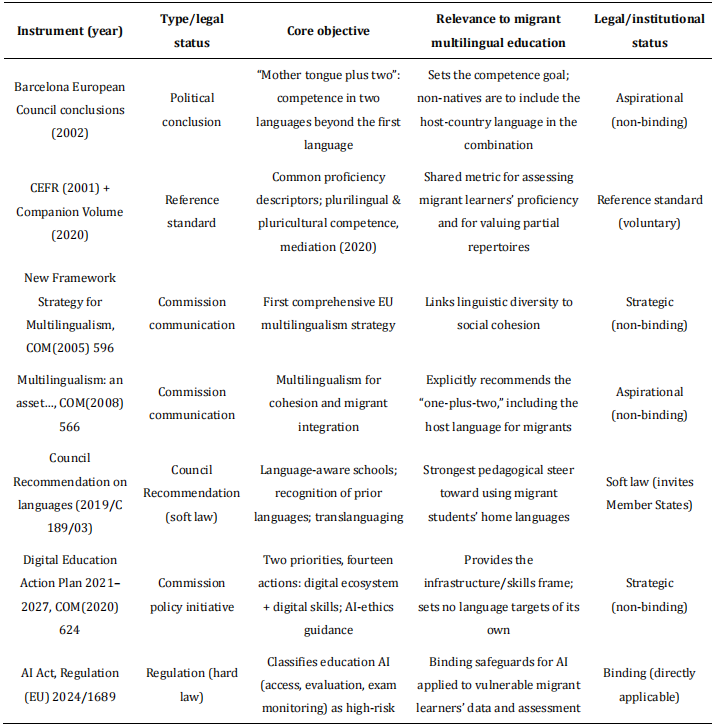
While these frameworks present digital transformation and multilingual education as mutually reinforcing, the literature suggests their relationship is more complex in practice. Implementation varies across national systems owing to differences in institutional capacity, digital infrastructure, and administrative coordination, and supranational aspirations are frequently reshaped, or diluted, as they pass through national and local structures [11]. The integration of technology into multilingual strategies therefore cannot be assumed to occur automatically; it depends on sustained alignment between supranational objectives and national realities.
3.2. National Multilingualism Policy: The Greek Case
Historically monolingual in orientation, Greece has incorporated multilingual provisions largely in response to migration. Reception Classes (Tάξεις Υποδοχής) were first established for repatriated and immigrant students by Ministerial Decision in 1980, and the system now also operates intercultural education programs and Intercultural Schools under the Ministry of Education [18]. Successive migration flows, intensifying after 2015, brought large numbers of immigrant and refugee students with diverse first languages into mainstream classrooms and prompted the reactivation and expansion of Reception Classes [19].
Despite this institutional apparatus, research consistently reports a gap between formal provision and classroom reality. Studies of Greek teachers’ attitudes describe an “invisible bilingualism” in which students’ heritage languages are frequently regarded as a hindrance to Greek acquisition rather than as a resource, and are largely absent from institutional practice [20,21]. In this sense, multilingualism has often functioned as an institutional aspiration insufficiently supported by infrastructure, materials, or systematic teacher preparation. Research on teaching Greek as a second or heritage language emphasizes that effective practice depends on multimodal materials, technological tools, and trained teachers, and that a full embrace of intercultural and translanguaging principles remains uneven across schools [6,22].
Several constraints recur in the Greek context: insufficient teacher training in digital and intercultural pedagogy, and unequal access to equipment and connectivity across regions and school types [11,21]. Initiatives under European and nationally funded programs, such as Erasmus+, eTwinning, and Content and Language Integrated Learning (CLIL) projects, alongside earlier teacher-support schemes such as “Diapolis,” indicate movement toward more inclusive multilingual pedagogy [19]. Evidence on their long-term effect is mixed: such programs can raise intercultural awareness and linguistic exposure, but their impact appears to depend less on project visibility than on systemic alignment with teacher training, infrastructure, and national planning, a point that bears directly on the study’s research question. Figure 1 depicts this policy-to-practice pathway and the conditions that bridge or widen the implementation gap.
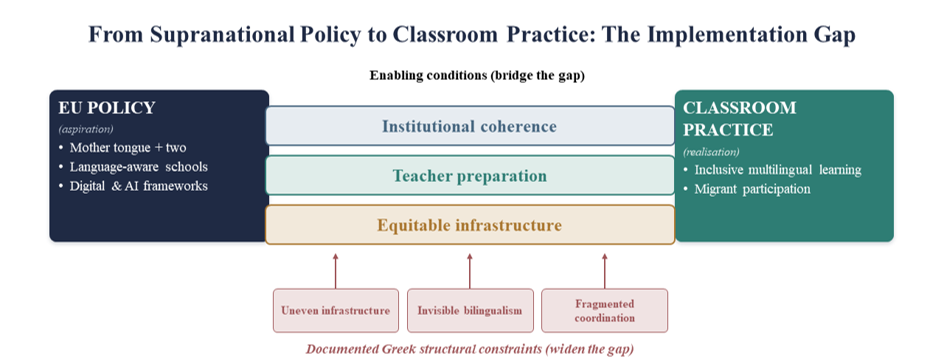
Figure 1. EU policy aspirations translate into classroom practice only when enabling conditions bridge the implementation gap; documented national constraints act to widen it.
3.3 The Role of Technology in Multilingualism Policy
Technology conditions how multilingualism policy is realized. Digital multilingual pedagogy links linguistic and cultural competence with digital literacy, and collaborative platforms, digital portfolios, and communities of practice can support interaction and metalinguistic awareness [23]. However, technology can also reproduce “digital monolingualism” where linguistic representation is unbalanced: a tool available only in a dominant language such as English may perpetuate rather than reduce inequality, a risk that is now well documented at the level of the underlying language technologies [9]. Multilingualism is understood here as an individual’s capacity to use more than one language, at varying proficiency levels, across social and professional contexts—a social and political phenomenon tied to citizenship, employability, and cultural democracy [3].
Three theoretical positions inform the analysis. Sociocultural theory holds that learning occurs through social interaction and cultural mediation, with tools, including digital ones, functioning as mediators between the learner and knowledge [24]. Translanguaging theory proposes that bilingual learners draw on a single, integrated linguistic repertoire fluidly, without rigid boundaries between named languages; digital environments can support this flexibility through multimodal and interactive activity [25]. Critical digital pedagogy adds that technology is not neutral but embeds particular values, assumptions, and power relations, so that its adoption is always also a political choice [26].
Within educational technology (EdTech), mobile-assisted language learning (MALL) enables individualized, situated practice and feedback on portable devices, extending learning beyond the classroom and supporting both synchronous and asynchronous interaction [27]. Learning-management systems (Moodle, Canvas, Google Classroom) support multilingual content and collaboration; MOOCs and applications such as Duolingo and Memrise broaden access. In Greece, use of such tools in teaching Greek as a second language remains limited but is expanding through Erasmus+ and eTwinning, and requires the combined development of language-teaching and techno-pedagogical skills, the integration of content, pedagogy, and technology that the TPACK framework describes [28]. The Greek case reflects a broader European pattern: multilingualism is formally recognized, but its realization depends on infrastructure, teacher preparation, and institutional coherence.
4 Digital Pedagogies and Learning Technologies
Three functions recur across the reviewed literature.
Access and empowerment: Technology can provide access to resources independent of time and place, and adaptive online programs may increase confidence and participation among students with a migrant background [7]. Digital environments can also offer lower-stakes settings for self-expression, which may be valuable for learners whose schooling has been interrupted.
Intercultural communication: Collaborative online learning can support intercultural understanding through the exchange of experience across linguistic and cultural boundaries, consistent with a sociocultural account of learning as jointly constructed [24].
Personalization: Adaptive tools can adjust to learner level and need; students with discontinuous schooling, common among migrant learners, may particularly benefit from individualized paths and automated feedback [8].
Digital tools may be grouped into four categories: learning-management systems (Moodle, Canvas, Google Classroom); mobile applications (Duolingo, Babbel, Memrise); AI-based tools (e.g., Grammarly, ChatGPT) offering adaptive feedback; and virtual/augmented-reality systems (e.g., ImmerseMe, Mondly VR) that simulate communicative scenarios. Several European initiatives combine language learning with digital empowerment for social participation, and the CEFR/ELP instruments provide a common competence reference across them [1,13].
Persistent challenges qualify these opportunities: insufficient techno-pedagogical competence among educators, which the TPACK literature identifies as a core determinant of effective integration [28]; the digital divide across socioeconomic groups, which is now understood less as a binary of access than as graded inequalities in connectivity, skills, and usage [29]; cultural and linguistic imbalance in content, where major languages dominate available resources and low-resource languages are underserved [9,10]; and ethical and data-protection concerns around AI. Institutional discontinuity is a further concern, as multilingual policies are often set strategically without consistent evaluation mechanisms. Without institutional coordination, multilingualism risks remaining declaratory rather than operational.
Implementation also depends on teacher agency. Educators actively mediate pedagogical change rather than passively receiving reform; whether reform is realized depends on the interaction of teachers’ dispositions, resources, and structural conditions [30]. Resistance may arise from insufficient training, increased workload, or concerns about professional autonomy. Sustained professional development, participatory planning, and institutional support are therefore preconditions rather than accompaniments.
4.1 Artificial Intelligence as an Educational System: Capability, Risk, and Governance
AI in multilingual education is best understood not as a single tool but as an evolving system that shapes access to knowledge, linguistic representation, and institutional decision-making. Generative AI and multilingual large language models (LLMs) increasingly influence language production, translation, assessment, and feedback, and can generate adaptive explanations and multilingual content for differentiated instruction [7,8].
These systems are not linguistically neutral. Training corpora overrepresent dominant, well-resourced languages, and quantitative analyses show that the large majority of the world’s languages have little or no presence in the datasets and benchmarks on which modern language technologies are built, with performance degrading sharply for low-resource languages [9]. Large uncurated web corpora further encode the cultural and social biases of their dominant sources [10]. This is a material limitation for migrant education specifically, because many languages spoken by migrant and refugee learners may be comparatively under-resourced in NLP systems, creating a potential risk of unequal AI-supported educational performance. Consequently, AI cannot be assumed to serve all target languages equally; where a learner’s first language is poorly represented, AI may reinforce rather than reduce existing hierarchies. The limited explainability of generative models compounds the problem, since automated feedback without transparent reasoning may constrain critical reflection and teacher oversight.
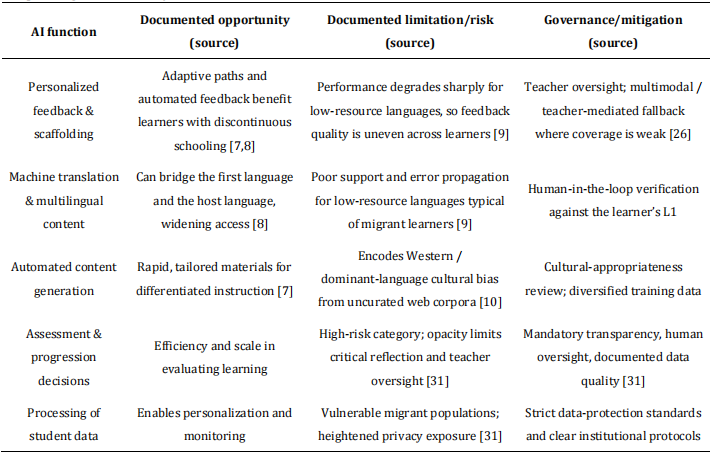
AI integration also raises governance questions. Under the EU Artificial Intelligence Act [31], AI systems used to determine access to education, to evaluate learning outcomes, or to monitor examinations are classified as high-risk and are subject to corresponding obligations regarding data quality, transparency, and human oversight. Processing of student data, especially for vulnerable migrant populations, requires strict adherence to data-protection standards and clear institutional protocols. AI in this domain is therefore better conceived as a regulated, context-sensitive educational infrastructure whose contribution to inclusion depends on pedagogical mediation, linguistic diversity in training data, and alignment with regulatory safeguards. Table 2 summarizes this capability-risk-governance balance across the principal AI functions.
Table 2. Artificial intelligence in migrant multilingual education: Capability contrasted with risk and required governance, by function
5 A Proposed Model of Multilingual Digital Education
Across the reviewed literature, four interdependent components recur: the political-institutional framing of multilingual policy; the pedagogical mediation of digital environments; the technological capacity of AI-supported systems; and the social implications for inclusion and equity. The proposed model does not advance a new theoretical claim; it systematizes these dimensions into an explicit structure and adapts them to the structural characteristics of the Greek system, including regional disparities in infrastructure and variation in teacher preparation [11,21]. It should therefore be read as a structured synthesis of the literature, not as an empirically validated framework (Figure 2).
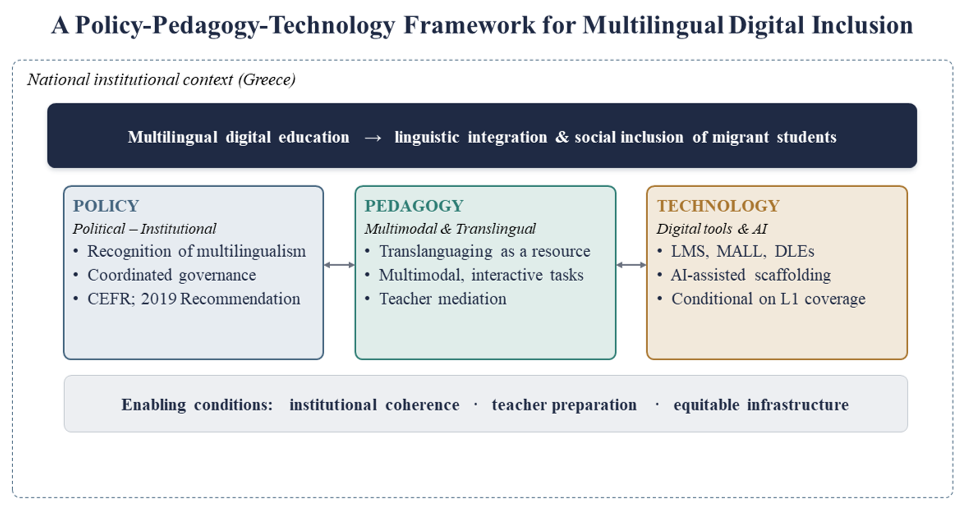
Figure 2. The proposed framework. Three interdependent dimensions: policy, pedagogy, and technology, rest on shared enabling conditions and, operating within the national institutional context, converge on the linguistic and social inclusion of students with migrant backgrounds.
5.1 The Four Components
(1) Political component (multilingualism as public policy): Institutional recognition of multilingualism across all levels of education; establishment of national digital platforms for language education; and defined evaluation indicators [3,17].
(2) Pedagogical component (education through multimodality): Integration of linguistic and intercultural competences; use of multimodal resources and virtual environments; and incorporation of translanguaging as a resource rather than a deficit [6,25].
(3) Technological component (innovation and accessibility): Design of AI-based tools able to adapt across languages, with explicit recognition that current systems underperform for low-resource languages; and development of open, multilingual datasets [9]. Where AI performance for a learner’s first language is inadequate, the model prioritizes teacher-mediated and multimodal alternatives rather than defaulting to AI.
(4) Social component (participation and empowerment): Creation of digital learning communities premised on equality and collaboration, and cultivation of linguistic tolerance through dialogue [24].
The four interdependent components are shown in Figure 3.
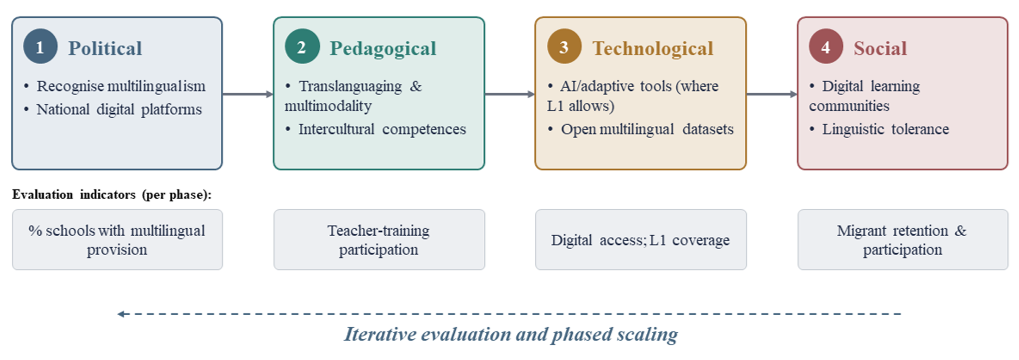
Figure 3. The four interdependent components of the model, each paired with a measurable evaluation indicator. The dashed loop denotes iterative evaluation and phased scaling based on institutional readiness.
5.2 Application in Greece
European policies cannot be transferred to Greece as ready-made solutions. Their integration depends on institutional capacity, administrative coordination, and the linguistic composition of local school communities [11]. Table 3 cross-tabulates the four components against documented conditions in the Greek system, pairing each policy aspiration with the specific constraint the literature records and with a corresponding lever and indicator, across the principal AI functions, while Figure 4 sets out the corresponding decision logic for choosing an AI-assisted versus a teacher-mediated pathway.
Table 3. The proposed four-component model cross-tabulated against documented conditions in the Greek system: Aspiration vs. evidenced constraint vs. lever vs. indicator
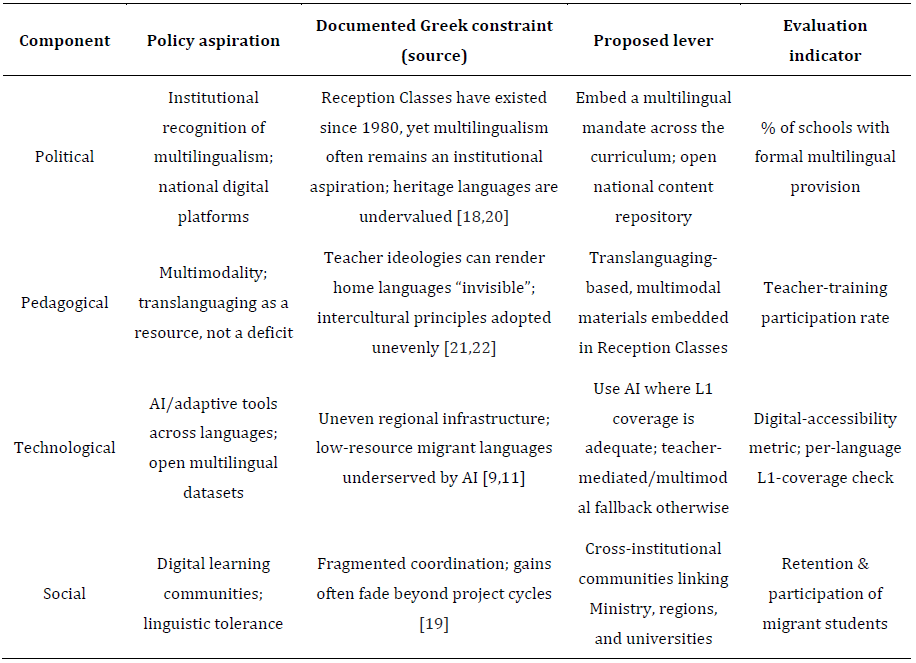
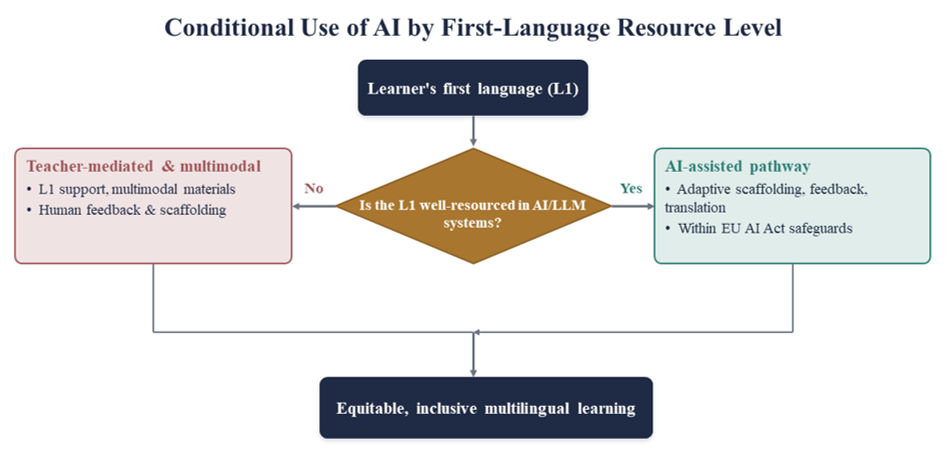
Figure 4. A decision schematic operationalizing the article’s central qualification. Because most migrant first languages are low-resource [9], AI is used only where L1 coverage is adequate; otherwise, teacher-mediated, multimodal support preserves equity. All AI use remains within EU AI Act governance.
In practical terms, implementation could begin with structured pilots in Reception Classes and Intercultural Schools, where support mechanisms already exist [18,19]. Pedagogically, this would mean embedding AI-assisted scaffolding and adaptive-feedback tools, and, where AI coverage of a learner’s first language is weak, multimodal and teacher-mediated alternatives, within existing curricula rather than establishing parallel programs [22]. Institutionally, it would require coordinated planning between the Ministry of Education, regional authorities, and teacher-training bodies to secure infrastructure, professional development, and monitoring. A phased rollout with predefined indicators, for example, teacher-training participation and digital-accessibility metrics, would allow scaling according to institutional readiness. Concrete initial actions include equipping Reception Classes with digital tools (tablets, LMS access), training educators in MALL and AI-based tools [27,28], and partnering with universities on intercultural education programs.
6 Discussion
The relationship between multilingualism, technology, and education is multidimensional rather than linear. EU policy seeks to combine digital innovation with social cohesion, but realization depends on national strategies and infrastructure, and supranational aspirations are reshaped as they descend to national and school levels [11]. In Greece, multilingual provision in education and administration is applied inconsistently and is constrained by limited infrastructure and by teacher ideologies that can render students’ home languages invisible [20,21]. Technology may accelerate policy translation only where it is applied pedagogically rather than technically, and where it is supported by a robust institutional framework, adequate teacher competence, and systematic evaluation [26,28].
Two qualifications follow from the analysis. First, technology alone does not ensure inclusion; the political dimension, recognition of language rights and coordinated governance, is at least as important as the technical one [3]. Second, the inclusive potential of AI is conditional: for the low-resource languages common among migrant learners, current systems may underserve exactly the populations the policy intends to support [9,10]. Recognizing this constraint is necessary if “technology-supported multilingualism” is to function as a genuine instrument of equity rather than a rhetorical one.
However, there are several limitations in this study. As discussed in the methodology section, this study is a narrative rather than a systematic review, so its selection, although criteria-based, is not exhaustive and remains open to database- and language-selection bias; the restriction to English-language sources may have excluded relevant work published in Greek and other languages, and the reliance on published literature leaves the synthesis exposed to publication bias. The evidence base is heterogeneous in design and quality, and empirical evidence specific to the Greek context is limited. The analysis draws on secondary sources rather than primary classroom data, and the proposed four-component model is a conceptual synthesis that has not been empirically tested. Finally, both AI technologies and the regulatory environment surrounding them are evolving rapidly, so specific tools and provisions discussed here may date quickly. For these reasons, the findings are interpretive and associational: they identify conditions compatible with inclusive multilingual digital education but cannot establish the causal effect of digital tools on learning or integration outcomes, which would require prospective, context-specific empirical testing.
7 Conclusion
This study centers on how digital learning environments can operationalize multilingual policy to support the linguistic and social inclusion of migrant students. The narrative synthesis suggests that digital learning environments may contribute to multilingual and social inclusion when supported by institutional coherence, pedagogical mediation, appropriate technological adaptation, and equitable infrastructure. These relationships remain to be tested empirically. In the Greek context, where migration has reshaped public education, the proposed four-component model offers a structured, though untested, pathway for aligning political commitment, pedagogical practice, and technological design. Digital multilingual education operates less as a technical solution than as an institutional mechanism for inclusion, effective only when embedded in coherent policy structures and supported by trained educators. Empirical validation through pilot implementation, with defined evaluation indicators, is the necessary next step.
Conflicts of Interest
The authors declare no conflicts of interest.
References
[1] Council of Europe. Council for Cultural Co-operation. Education Committee. Modern Languages Division. (2001). Common European framework of reference for languages: Learning, teaching, assessment. Cambridge University Press.
[2] Pozzo, B. (2007). Multilingualism as a value in the European Union. In Multilanguage complexity of European law: Methodologies in comparison: Workshop, 17 November 2006, European University Institute, Fiesole, Italy (pp. 1000–1011). European Press Academic Publishing.
[3] Skutnabb-Kangas, T. (2013). Linguistic genocide in education—or worldwide diversity and human rights? Routledge.
[4] Bridges, B., & Walls, N. (2018). Migration, displacement and education. UNESCO Publishing.
[5] Cerna, L., Brussino, O., & Mezzanotte, C. (2021). The resilience of students with an immigrant background: An update with PISA 2018. OECD Education Working Papers, 261, 1–69. https://doi.org/10.1787/e119e91a-en
[6] Cummins, J. (2000). Language, power, and pedagogy: Bilingual children in the crossfire (Vol. 23). Multilingual Matters.
[7] Luckin, R., & Holmes, W. (2016). Intelligence unleashed: An argument for AI in education. Pearson.
[8] Fadel, C., Holmes, W., & Bialik, M. (2019). Artificial intelligence in education: Promises and implications for teaching and learning. Center for Curriculum Redesign.
[9] Joshi, P., Santy, S., Budhiraja, A., Bali, K., & Choudhury, M. (2020). The state and fate of linguistic diversity and inclusion in the NLP world. In Proceedings of the 58th annual meeting of the Association for Computational Linguistics (pp. 6282–6293). Association for Computational Linguistics.
https://doi.org/10.18653/v1/2020.acl-main.560
[10] Tao, Y., Viberg, O., Baker, R. S., & Kizilcec, R. F. (2024). Cultural bias and cultural alignment of large language models. PNAS Nexus, 3(9), pgae346.
https://doi.org/10.1093/pnasnexus/pgae346
[11] Hajisoteriou, C., & Angelides, P. (2016). The globalisation of intercultural education: The politics of macro–micro integration. Palgrave Macmillan.
[12] Grant, M. J., & Booth, A. (2009). A typology of reviews: An analysis of 14 review types and associated methodologies. Health Information & Libraries Journal, 26(2), 91–108.
[13] Council of the European Union. (2020). A comprehensive approach to the teaching and learning of languages. European Journal of Language Policy, 12(1), 109–121.
[14] European Council. (2002). Presidency conclusions, Barcelona European Council, 15–16 March 2002 (SN 100/1/02 REV 1).
[15] Commission of the European Communities. (2003). Communication from the Commission—Promoting language learning and linguistic diversity: An action plan 2004–2006 (COM(2003) 449 final). https://eur-lex.europa.eu/legal-content/EN/TXT/?uri=CELEX:52003DC0449
[16] European Commission. (2020). Communication from the Commission to the European Parliament, the Council, the European Economic and Social Committee and the Committee of the Regions. Brussels.
[17] European Commission. (2020). Communication from the Commission to the European Parliament, the Council, the European Economic and Social Committee and the Committee of the Regions—Digital Education Action Plan 2021–2027: Resetting education and training for the digital age (COM(2020) 624 final).
[18] Giavrimis, P., & Dimitriadou, S. (2023). Interculturality in Greek education. Journal of Ethnic and Cultural Studies, 10(3), 72–88.
[19] Chatzidaki, A., & Tsokalidou, R. (Eds.). (2021). Challenges and initiatives in refugee education: The case of Greece. Cambridge Scholars Publishing.
[20] Gkaintartzi, A., Kiliari, A., & Tsokalidou, R. (2015). ‘Invisible’ bilingualism–‘invisible’ language ideologies: Greek teachers’ attitudes towards immigrant pupils’ heritage languages. International Journal of Bilingual Education and Bilingualism, 18(1), 60–72. https://doi.org/10.1080/13670050.2013.877418
[21] Mattheoudakis, M., Chatzidaki, A., & Maligkoudi, C. (2017). Greek teachers’ views on linguistic and cultural diversity. Selected Papers on Theoretical and Applied Linguistics, 22, 358–371.
[22] Mogli, M., & Goudoufa, S. (2025). Teaching Greek to refugee and migrant students: Primary school teachers’ educational methods and approaches. In Advances in second and foreign language acquisition: From Greek classrooms to global contexts (pp. 73–111). Springer Nature Switzerland.
https://doi.org/10.1007/978-3-031-94298-3_4
[23] Bialystok, E. (2001). Bilingualism in development: Language, literacy, and cognition. Cambridge University Press.
[24] Vygotsky, L. S. (1978). Mind in society: The development of higher psychological processes. Harvard University Press.
[25] García, O., & Wei, L. (2014). Translanguaging: Language, bilingualism and education. Palgrave Macmillan.
[26] Selwyn, N. (2016). Is technology good for education? John Wiley & Sons.
[27] Kukulska-Hulme, A., & Shield, L. (2008). An overview of mobile assisted language learning: From content delivery to supported collaboration and interaction. ReCALL, 20(3), 271–289. https://doi.org/10.1017/S0958344008000335
[28] Mishra, P., & Koehler, M. J. (2006). Technological pedagogical content knowledge: A framework for teacher knowledge. Teachers College Record, 108(6), 1017–1054.
[29] Van Dijk, J. (2020). The digital divide. John Wiley & Sons.
[30] Priestley, M., Biesta, G., & Robinson, S. (2026). Teacher agency: An ecological approach. Bloomsbury Publishing.
[31] Lognoul, M. (2025). Regulation (EU) 2024/1689 laying down harmonised rules on artificial intelligence (Artificial Intelligence Act–AI Act). Revue du Droit des Technologies de l’Information, (3–4), 145–189.